About Chalciporus piperatus (Bull.) Bataille
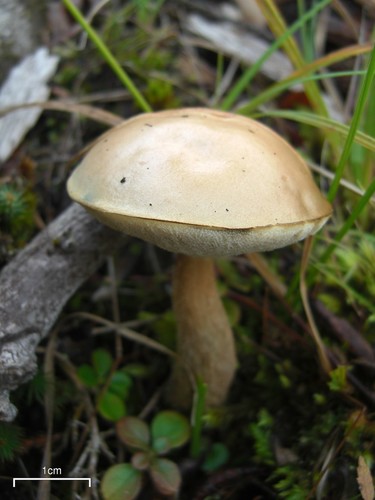
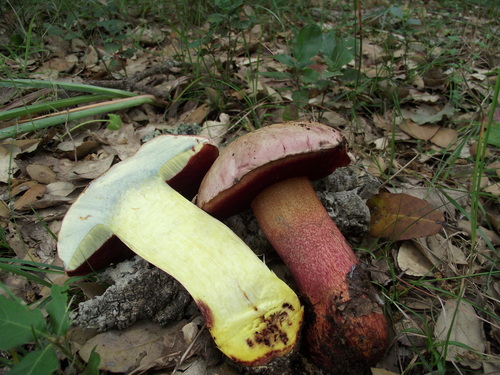
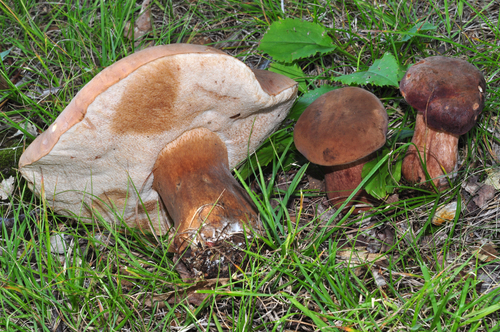
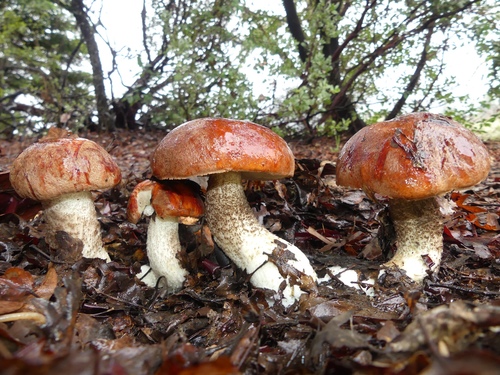
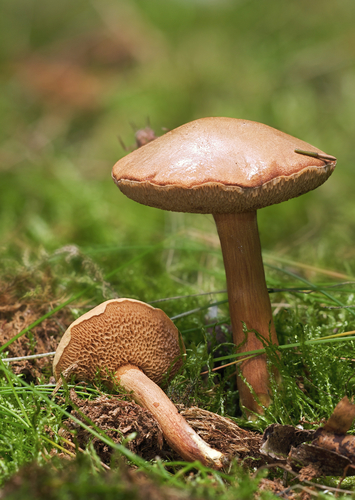
Chalciporus piperatus (Bull.) Bataille is one of the smaller bolete fungi. Its cap measures 1.6–9 cm across, is orange-fawn in colour, and starts convex before flattening as it ages. The cap surface may be furrowed, is shiny when dry and slightly sticky when wet, and can crack with age. The pore surface ranges in colour from yellowish to dark reddish brown when the mushroom reaches maturity, and stains brown when bruised. Individual pores are angular, 0.5–2 mm wide, while the spore-bearing tubes are 3–10 mm deep. The stipe is slender for a bolete, measuring 4–9.5 cm long by 0.6–1.2 cm thick; it is roughly uniform in width along its length, or slightly wider near the base. The stipe is a similar colour to the cap, or lighter, and has yellow mycelium at its base. The flesh is yellow, sometimes with reddish tones, and matures to purplish brown. It has no odour, and produces a brown to cinnamon spore print. Two varieties of this species are recognized: variety hypochryseus is nearly identical to the main species form except for its bright yellow tubes and pores, while variety amarellus has pinker pores and a bitter rather than peppery taste. Microscopically, the spores are smooth, narrowly fusiform (fuse-shaped), and measure 7–12 by 3–5 μm. The spore-bearing basidia are 20–28 by 6–8 μm, hyaline (translucent), four-spored, narrowly club-shaped, and contain many internal oil droplets. Cystidia are fusiform, sometimes with a rounded tip, and measure 30–50 by 9–12 μm; some are more or less hyaline, while others are encrusted with golden pigment. The cap cuticle is a trichodermium, where the outermost hyphae emerge roughly parallel like hairs perpendicular to the cap surface. These hyphae are 10–17 μm wide, with elliptical to cylindrical non-gelatinous end cells, and no clamp connections are present on the hyphae. Fruit bodies grow singly, scattered, or in groups on the ground. This fungus grows naturally in or near coniferous, beech, or oak woodlands, often on sandy soils. In Europe, fruit bodies appear in late summer and autumn, from August to November. It is widespread across North America, fruiting from July to October in eastern states and from September to January on the Pacific Coast. It is also found in Mexico and Central America; in Asia, it has been collected from Pakistan, West Bengal (India), and Guangdong Province (China); in South Africa, it is known from southwestern Cape Province and eastern Transvaal Province. It grows in conifer plantations in association with Amanita muscaria (fly agaric) and Cantharellus cibarius (chanterelle). It has been recorded under introduced loblolly pine (Pinus taeda) plantations in Santa Catarina and Paraná states in southern Brazil, and under introduced trees in the Los Lagos Region of Chile. It has also spread into native forest in northeastern Tasmania and Victoria, Australia, where it is found growing with the native Nothofagus cunninghamii (myrtle beech). The rare variety hypochryseus occurs only in Europe, specifically in Austria, Czechia, Greece, Italy, and Spain. Also rare, variety amarellus is widespread in European coniferous forests, where it is usually found near pines, spruce, and sometimes fir. Fruit bodies of C. piperatus can be parasitized by the mould Sepedonium chalcipori, a highly specialized mycoparasite that is only known to infect this bolete. Infections cause necrotic mushroom tissue and the production of large amounts of yellow conidia. Like most boletes, C. piperatus was initially thought to form ectomycorrhizal symbiosis with plants, but multiple synthesis studies and isotope fractionation studies have not confirmed this symbiosis. Some researchers speculate that C. piperatus is a mycoparasite that grows on the mycorrhiza of A. muscaria. In New Zealand, A. muscaria is thought to have been introduced with Pinus radiata, and has since made a host jump to native Nothofagus trees; C. piperatus has since been observed fruiting near Nothofagus trees that host A. muscaria. Buchwaldoboletus lignicola, which falls in the same clade as C. piperatus, is also thought to be a parasite, which supports the hypothesis that C. piperatus and its relatives may be mycoparasites. This mushroom contains toxins and is generally considered inedible. It has been used as a condiment in many countries; Italian chef Antonio Carluccio recommended using it only to add its peppery flavour to other mushrooms. Some sources recommend that it be well-cooked before consumption to reduce the risk of gastric symptoms, but cooking removes its peppery taste, and this loss is even greater when the mushroom is ground into powder. Fruit bodies can be used to make mushroom dye; depending on the mordant used, yellow, orange, or greenish-brown dyes can be produced.