About Chalcides striatus (Cuvier, 1829)
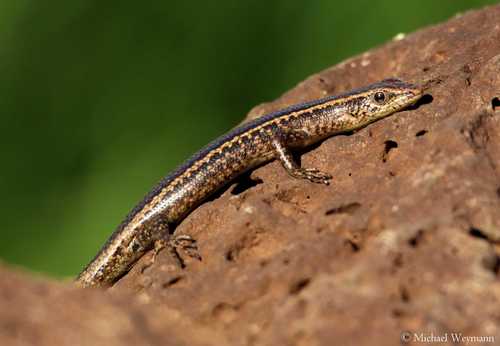
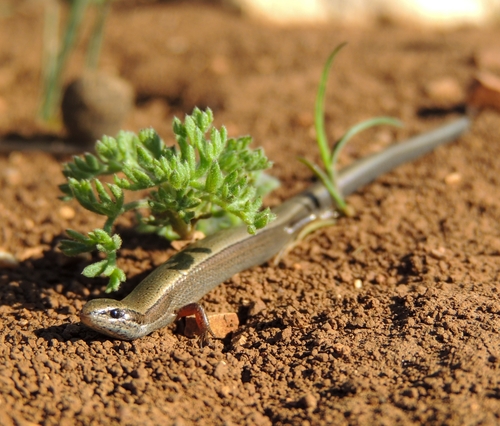
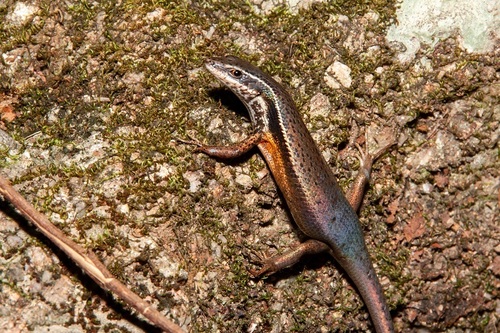
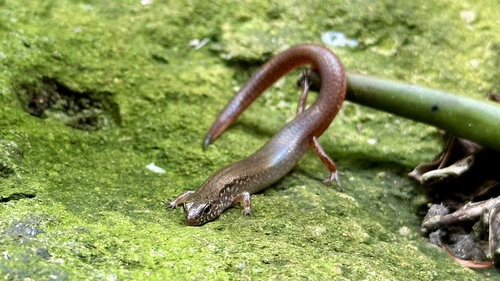
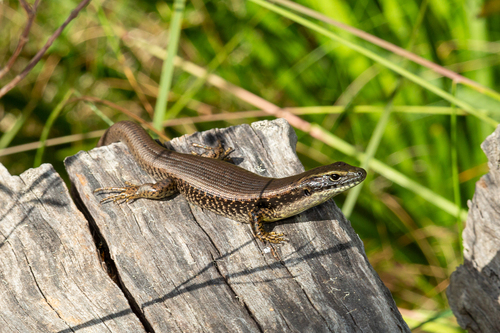
This species of skink, Chalcides striatus, commonly called the western three-toed skink, looks superficially like a snake, except it has two pairs of tiny, three-toed limbs. It has a small head and thick neck, and reaches a total length of about 43 cm (17 in). Its scales are smooth and glossy, and its base body color is silvery or bronze, with around ten thin, dark longitudinal lines running along its body. Its head is usually darker than the rest of its body. It can be told apart from the closely similar Italian three-toed skink (Chalcides chalcides) by its slightly larger limbs, and by the fact that all three toes on its hind feet are the same length. The western three-toed skink is native to southwestern Europe. Its distribution covers Liguria in extreme northwestern Italy, southern France, Spain, and Portugal. It does not appear to be present in eastern Spain, and there is an isolated population near Bordeaux in southwestern France. It can be found at elevations up to 1,800 m (5,906 ft) above sea level. Its typical habitat is damp, sunny areas with dense low vegetation, including meadows, stream verges, marshes, grassy slopes, and hedgerows. In the western portion of its range, close to the Atlantic Ocean, it may also live in drier heathland with low scrub and gorse.