About Chalastra pellurgata Walker, 1862
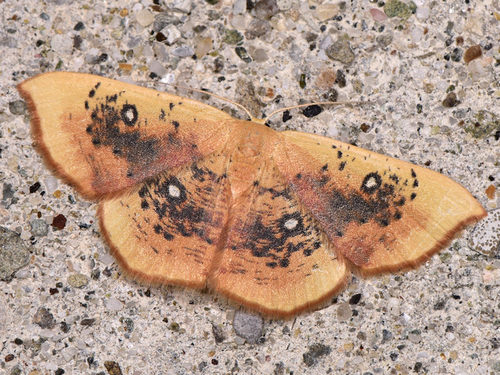
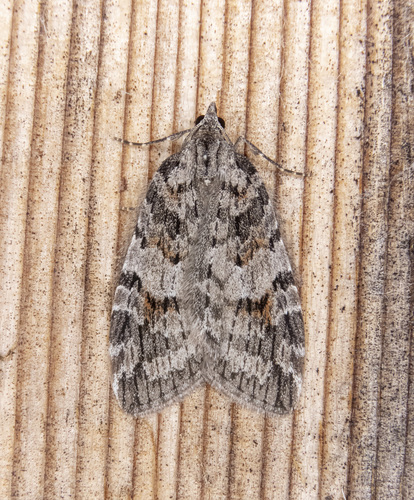
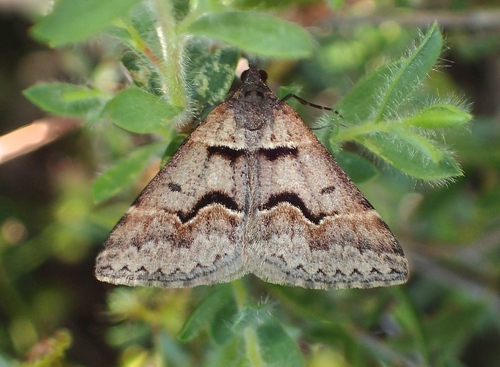
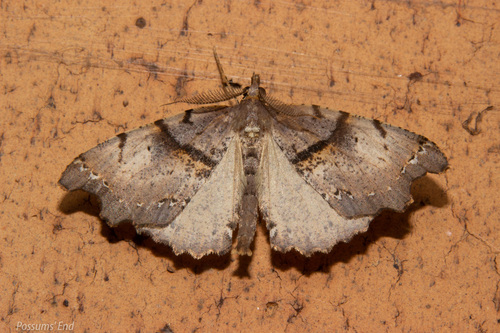
Hudson described the egg of Chalastra pellurgata as follows: the egg, which is laid flat, is oval and slightly flattened, deep bronzy-green, with a slight depression on its side, and covered in numerous indistinct shallow hexagonal depressions. Hudson also described the larvae of this moth: they are about 1+1⁄4 inches in length and very variable. Some specimens are dull brown, with a row of green or pale brown crescentic spots running down each side, and a dark brown line down the back. Other specimens are bright green, with a diagonal reddish-brown stripe on the side of each segment. The segmental divisions are reddish-brown, intersected by numerous very minute whitish lines. C. pellurgata larvae pupate on the soil surface under their host plants inside a loose cocoon. Hudson described the adult of this species as follows: the wing expansion is about 1+3⁄8 inches. Male forewings vary in colour from orange-brown to pale yellowish to pale slaty-brown. There is a doubly curved dark brown transverse line near the base, a broad straight line a little before the middle of the wing, an angulated line a little beyond the middle, and a curved subterminal line that is usually made up of a series of triangular white dots edged with dark brown. All of these lines are much stronger on the costa, and are sometimes almost completely obliterated in other areas of the wing. The hindwings are pale yellow or whitish, with several brown-edged white spots near the tornus. The apex of the forewing is considerably elongated, and there is a large rounded projection on the middle of the termen. The termen of the hindwings is distinctly indented. In the female, the forewings are pale yellow or orange. The transverse lines and white spots are usually more conspicuous, and the projections on the termen of the forewings and indentations on the termen of the hindwings are larger. Hudson noted that this is an extremely variable species: some male specimens are darker and marked with purplish-brown patches, compared to the paler orange-brown variety. Although these darker specimens can appear to be a separate species, a full series of specimens shows intermediate forms that connect the two extremes of colouration. Females of the species also vary, but tend to be lighter in colour than males. Both males and females have four dark lines across the forewing, but these lines tend to be more visible in females. In males, only the first, third and fourth of these lines are visible towards the leading edge of the forewing. This species is endemic to New Zealand, and can be found throughout the country. It inhabits native forest, and is commonly found in dense forest ravines.