About Chaetodontoplus mesoleucus (Bloch, 1787)
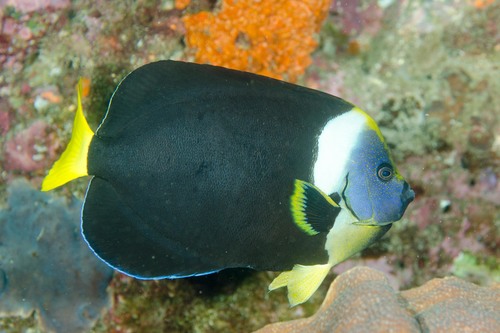
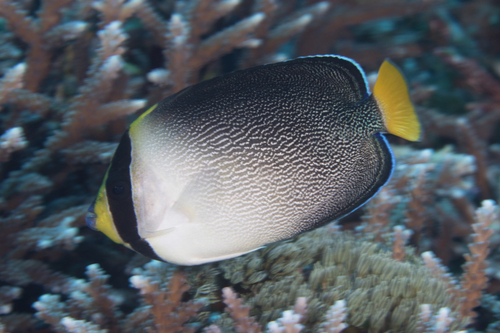
Chaetodontoplus mesoleucus has blue lips that contrast with its yellow face, and a black vertical band that runs through its eye. Behind its head, the body has an ash-gray area that gradually shifts into a larger black region covered entirely with yellow speckles. Its caudal fin is yellow, the dorsal and anal fins have a bright blue margin, and the pelvic fins are white. The dorsal fin contains 12 spines and 17 to 18 soft rays, while the anal fin has 3 spines and 17 to 18 soft rays. This species reaches a maximum total length of 18 centimetres (7.1 in).
Chaetodontoplus mesoleucus occurs in the western Indo-Pacific region. Its range extends from southern Japan (the northernmost point of its distribution) south through Indonesia, west to the Mentawai Islands, and east to the Bird's Head Peninsula of New Guinea, reaching as far south as northern Australia. In Australia, it can be found on reefs off the Kimberley Region of Western Australia south to Varanus Island, and also at Ashmore Reef in the Timor Sea.
This species inhabits depths between 1 and 30 metres (3.3 and 98.4 ft). It lives on continental shelf reefs and is rare around oceanic islands. It prefers silty inner coastal reefs and lagoons that have dense coral growth. Its diet consists of sponges, tunicates, and filamentous algae. It is usually found in small groups, and individuals hide among coral when alarmed. Like all other angelfish, it is a protogynous hermaphrodite: all individuals start out as female, and the dominant individuals change sex to become male.