About Chaetodontoplus duboulayi (Günther, 1867)
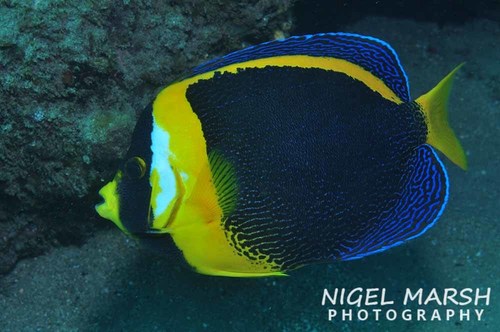
Chaetodontoplus duboulayi, also known as the scribbled angelfish, has a largely blue body marked with darker wavy lines. Its snout is yellow, and this yellow coloration also applies to its pectoral, pelvic, and caudal fins. A yellow stripe runs along the base of the dorsal fin, and there is a wide vertical yellow bar located to the rear of the eye, while the operculum is white. This species is sexually dimorphic: males have sinuous blue lines along their flanks, while females have yellow or blue spots. The dorsal fin contains 11 spines and 22 soft rays, and the anal fin contains 3 spines and 21 soft rays. This species reaches a maximum total length of 28 centimetres, or 11 inches. Chaetodontoplus duboulayi is found in the southwestern Pacific Ocean. Its range extends along the northern Australian coast from Shark Bay in Western Australia to Moreton Bay in Queensland, and as far south as Lord Howe Island in the Tasman Sea. It also occurs around the Aru Islands of Indonesia and along the southern coast of New Guinea, and there have been reported sightings of this species from Taiwan. Chaetodontoplus duboulayi lives at depths between 5 and 20 metres, or 16 and 66 feet. It inhabits coastal and inshore reefs that feature rubble areas, soft bottoms, or open rocky areas with substrates made up of rock outcroppings, coral, sponges, and seawhips. It is normally encountered in small groups. It feeds on benthic invertebrates, particularly sponges and tunicates. Like all other angelfish, it is a protogynous hermaphrodite: all individuals start out as female, and the dominant individuals later change sex to become male. In 1993, researchers began a study published in the Japanese Journal of Ichthyology focused on the spawning behavior of the scribbled angelfish. The study found that once laid, the eggs of this species range in size from 0.9 to 0.92 millimeters. It also found that the number of eggs produced after a spawning event can range from 5,000 to 33,000.