About Chaetodon xanthurus Bleeker, 1857
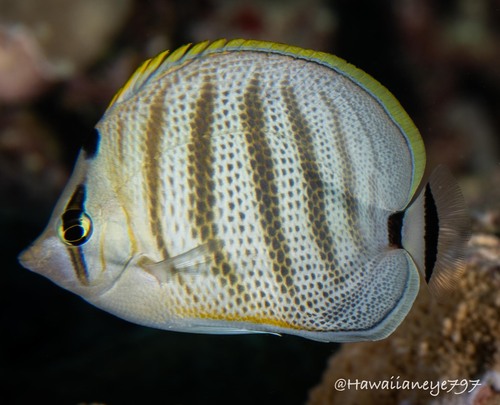
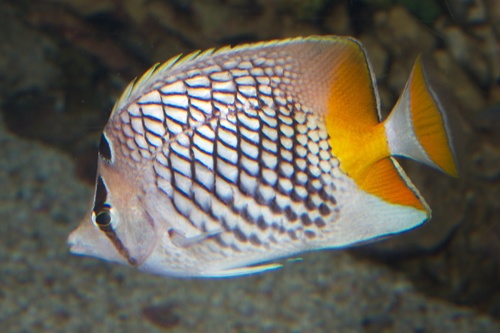
Pearlscale butterflyfish (Chaetodon xanthurus Bleeker, 1857) grow to a maximum standard length of 15 centimetres (5.9 in), with no observable size or appearance differences between males and females. Their bodies are pearly white, and each scale has a black edge, which creates a cross-hatched pattern along their sides, unlike the distinct chevron patterns seen in closely related species. The rear portion of their body is orange-yellow, and the base of their caudal fin is white. Their heads are darker than their bodies, and carry the characteristic marking pattern of their group: a vertical black eyestripe and a black crown spot rimmed with white. This species lives on and around reefs in the central Indo-Pacific region, ranging from Indonesia and the Philippines north to the Ryukyu Islands. Pearlscale butterflyfish are a diurnal species, most often found at depths below 6 metres (20 ft). They inhabit clear coastal to outer reef slopes and drop-offs, and are frequently found near staghorn Acropora corals. They have a generally peaceful temperament; in the wild, they can be found alone, in pairs, or in small groups. They are territorial towards species that look similar to them, and may harass these similar fish. Because of its attractive coloration, the Pearlscale butterflyfish is a popular aquarium fish. The minimum recommended aquarium size for this species is 50 gallons, and the water temperature should be kept between approximately 74 and 80° F. While they can be aggressive occasionally, they are delicate, and must be kept with peaceful tankmates to thrive in captivity. They may be compatible with other butterflyfish species that have different color patterns, but there is no guarantee that the two species will always get along peacefully. If you keep more than one Pearlscale butterflyfish in an aquarium, all individuals must be added to the tank at the same time. Providing lots of live rock with hiding shelters reduces stress for these fish. In the wild, they feed on algae, soft coral polyps, and small benthic invertebrates. Like other coral-eating Chaetodon species, they can cause significant damage to living corals kept in home aquariums. In captivity, they should be fed a varied diet that can include mysid shrimp, brine shrimp, krill, spirulina, and algae-containing foods.