About Chaetodon xanthocephalus Bennett, 1833
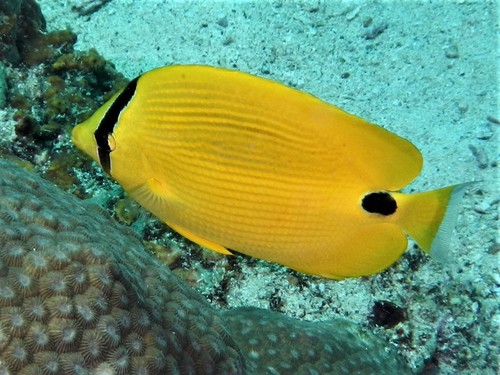
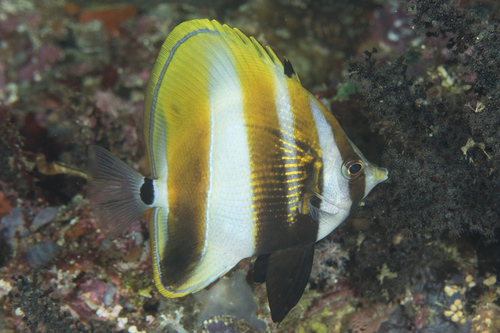
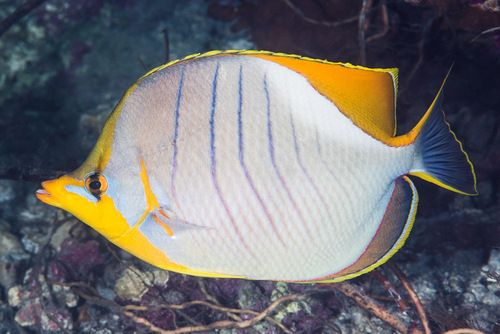
The yellowhead butterflyfish (Chaetodon xanthocephalus Bennett, 1833) has a pearly white body marked with greyish-blue chevrons, and golden-yellow coloration on the head, along the dorsal and ventral parts of the body, and on the fins. A short black vertical bar runs through its eyes, and a thin yellow line sits on the rear of its operculum. Its orange dorsal and anal fins have faint black markings on their lower rear sections and yellow margins, while the light grey caudal fin is also edged with yellow. The dorsal fin contains 13 to 14 spines and 21 to 26 soft rays, and the anal fin has 3 spines and 21 to 23 soft rays. This species reaches a maximum total length of 20 centimetres (7.9 in).
Yellowhead butterflyfish are widespread throughout the tropical waters of the Indian Ocean, ranging from Somalia to Durban in South Africa and Madagascar, east as far as Sri Lanka, western Thailand, and northwestern Sumatra.
They live at depths between 1 and 30 metres, usually found around isolated coral heads. They are typically solitary, but may form loose groups of 5 to 6 individuals. They are territorial and aggressive toward other butterflyfish (chaetodonts), and are omnivorous. When breeding, they form pairs; females swell when ready to spawn, and eggs are scattered into the water to be fertilized by males. The spherical eggs float, and hatch after an estimated 28 to 30 hours. After hatching, larvae develop a bony plate over their heads; this larval stage is called tholichthys, and larvae remain pelagic for a long period while slowly maturing into juveniles. This tholichthys life stage is what makes breeding butterflyfish in captivity so difficult.