About Chaetodon wiebeli Kaup, 1863
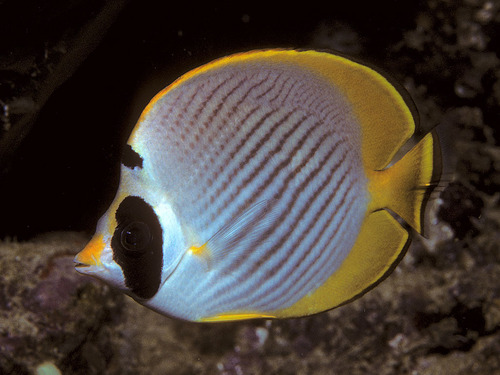
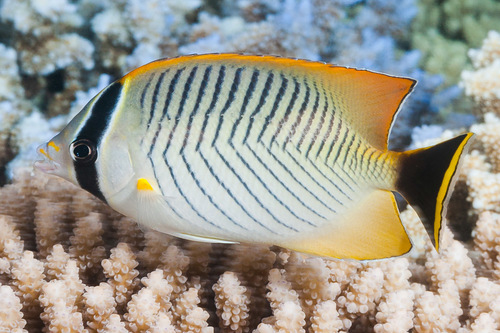
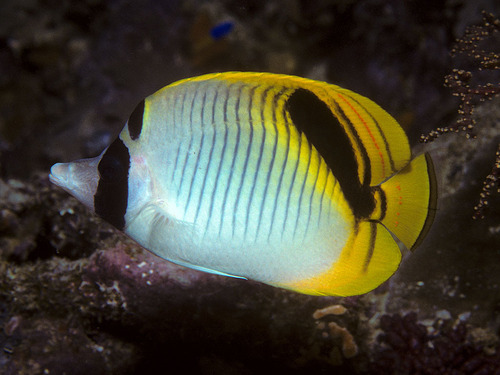
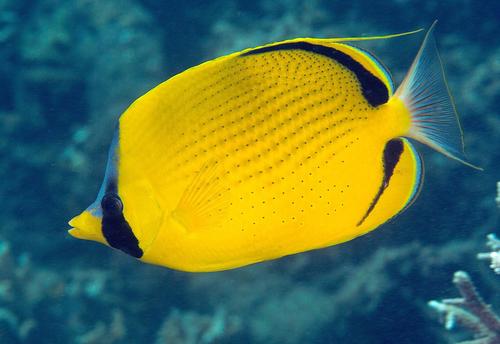
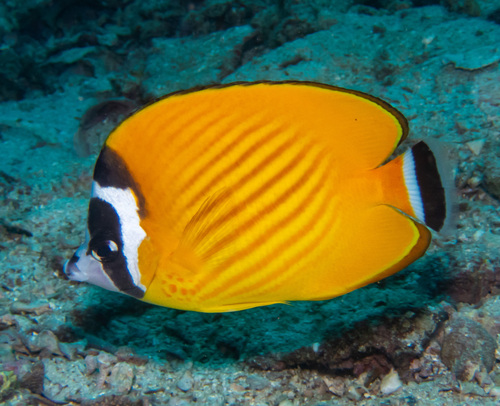
Chaetodon wiebeli Kaup, 1863 has an oval, deep, strongly compressed body. Its head has matching height and width, with a short snout, small protractile mouth, and setiform teeth in its jaws. The genus name Chaetodon means "bristle tooth", a reference to this tooth shape. This species has a smooth preopercle with no prominent spines. Its body is mainly yellow, marked with oblique brown lines. A vertical black band runs through the eye, with a white bar immediately behind this band, and there is a black blotch on the forehead. All of its fins—dorsal, anal, pelvic, and caudal—are yellow, though the caudal fin has a black margin. The dorsal fin has 12–13 spines and 22–25 soft rays, while the anal fin has 3 spines and 18–20 soft rays. This species reaches a maximum total length of 19 centimetres (7.5 in).
Chaetodon wiebeli occurs in the western Pacific Ocean, ranging from southern Japan and South Korea to northern Java, and extending into the Gulf of Thailand.
This species inhabits both rocky reefs and coral reefs, found at depths between 4 and 25 metres (13 to 82 ft). It is most often encountered in pairs or small shoals, but may also be solitary. It feeds on coral polyps, benthic invertebrates, and algae; its primary feeding method is grazing algae from rock surfaces. Chaetodon wiebeli is an oviparous species that forms mating pairs during breeding.