About Chaetodon vagabundus Linnaeus, 1758
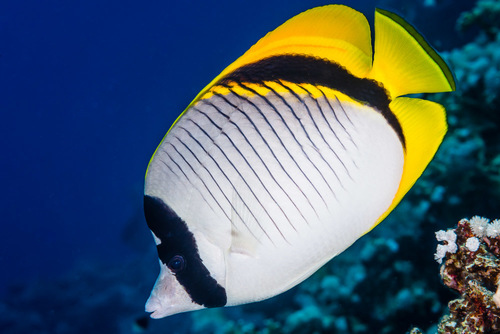
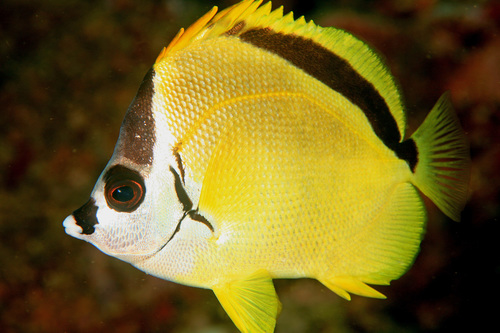
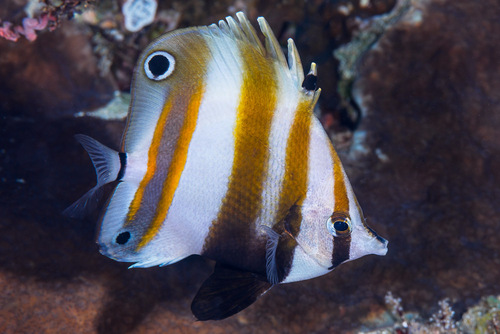
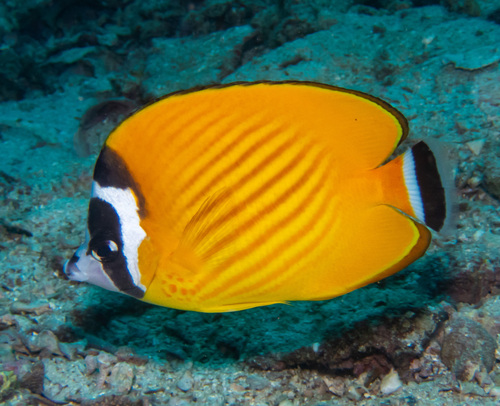
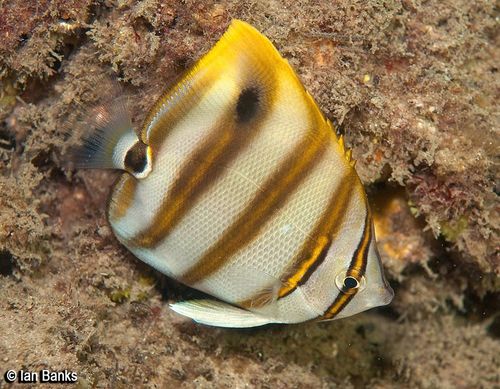
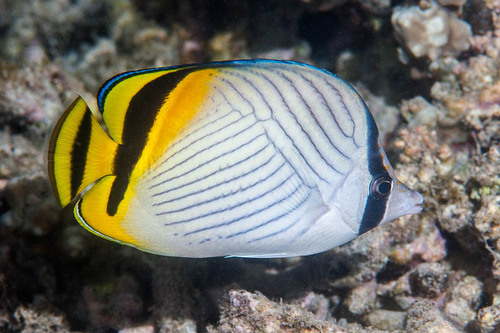
Chaetodon vagabundus Linnaeus, 1758, commonly called the vagabond butterflyfish, has a whitish body marked with two sets of thin, dark diagonal lines that are perpendicular to one another, creating a chevron pattern. It has a wide black vertical band that crosses through the eye, a second black vertical band across the caudal peduncle, and a third on the center of the caudal fin. Very thin orange horizontal lines run across its forehead. Juveniles have a black spot on the soft-rayed section of the dorsal fin, close to the posterior end. The dorsal fin of this species has 13 spines and 23 to 25 soft rays, while the anal fin has 3 spines and 19 to 22 soft rays. The vagabond butterflyfish reaches a maximum total length of 23 centimetres (9.1 in), with a more common typical length of 15 centimetres (5.9 in).
This species is distributed across the Indian and Pacific Oceans. Its range extends along the eastern coast of Africa from Socotra to KwaZulu-Natal, South Africa, east across the Indian Ocean as far as the Line and Gambier Islands in Polynesia, north to southern Japan, and south to New South Wales and Rapa Iti.
Vagabond butterflyfish inhabit reef areas, including coastal reef flats within reef systems, lagoons, and more exposed outer reef slopes. They can tolerate a range of environmental conditions, including turbid waters and freshwater plumes near stream mouths. They are omnivorous, feeding on algae, coral polyps, crustaceans, and worms. These fish are oviparous and monogamous, forming stable pairs in which both members jointly defend a shared feeding territory against other pairs. They often associate with other species without showing aggression. Compared to other species in its genus, the vagabond butterflyfish is easy to keep in aquariums.