About Chaetodon unimaculatus Bloch, 1787
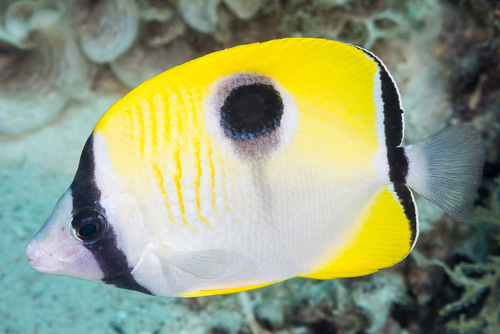
The teardrop butterflyfish (Chaetodon unimaculatus Bloch, 1787) has a whitish body, with yellow coloring on its dorsal, anal, and pelvic fins that also extends onto its back. A large teardrop-shaped black blotch marks its upper flank, and a wide black vertical bar runs through its eye. Delicate yellowish-orange chevron patterns appear on the flanks in front of the black teardrop blotch, and a second black vertical band runs from the rear of the dorsal fin, across the caudal peduncle, to the rear of the anal fin. Its dorsal fin has 12 to 13 spines and 19 to 23 soft rays, while its anal fin has 3 spines and 18 to 20 soft rays. This species reaches a maximum total length of 20 centimetres (7.9 in), though a length of around 16 centimetres (6.3 in) is more typical. This butterflyfish is distributed in the eastern Indian Ocean and western Pacific Ocean, ranging from Christmas Island and Cocos (Keeling) Island east as far as Hawaii, the Marquesas, and Ducie Island, north to Southern Japan, and south to Lord Howe Island in the Tasman Sea and the central coast of New South Wales. Teardrop butterflyfish are typically found in small groups on reef flats, in clear lagoons, and on seaward reefs, at depths between 1 and 60 metres (3.3 to 196.9 ft). They are most abundant in areas where leathery corals of the genera Sarcophyton and Sinularia grow. They feed on soft and hard corals, polychaetes, small crustaceans, and filamentous algae. This is an oviparous, monogamous species that forms breeding pairs to reproduce.