About Chaetodon ulietensis Cuvier, 1831
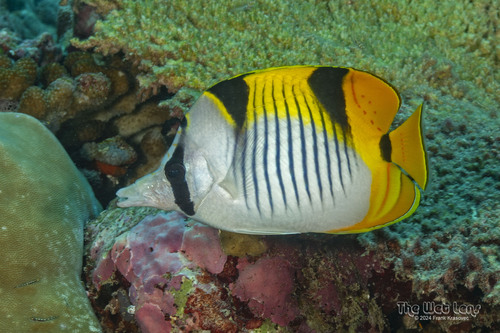
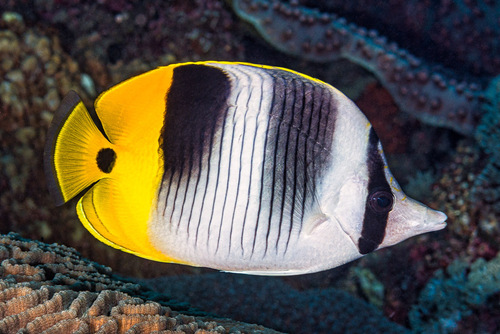
Description and systematics: This fish can grow up to 15 cm (5.9 in) in length. Its body is white, marked with thin vertical black lines running down its length. Two dark saddle-shaped markings sit on the front and rear of its back, which softly fade into the body color toward the tail. Right after the rear saddle, the body and tail are bright yellow, with a black spot on the caudal peduncle. The dorsal fin carries a yellow streak that runs from the top of the head to the tail. Like most of its close relatives, this species has a black band over the eye that looks like a mask. Just like most butterflyfish, the Pacific double-saddle butterflyfish tends to turn pale at night and when it is startled. C. ulietensis is part of the large subgenus Rabdophorus, which some consider distinct enough to be recognized as its own genus. Within this group, it is the closest relative of the similar-looking black-wedged butterflyfish, C. falcula. Other fairly close relatives are the quite differently shaped but similarly colored lined butterflyfish (C. lineolatus) and spot-naped butterflyfish (C. oxycephalus), while the blue-cheeked butterflyfish (C. semilarvatus) is the closest relative to all of these four species. All of these species have vertical body lines. All except C. semilarvatus also share a white body with yellow coloration on the rear, plus black markings on the back and caudal peduncle. Ecology: Chaetodon ulietensis is most often found alone or in pairs on coral-rich reef systems, where it forages on sessile invertebrates and algae. It is not a territorial species, and freely grazes across a wide range within reefs, lagoons, and harbors. Large groups will occasionally gather at locations with abundant food. It is very rarely found in deep reef environments or the open sea. Juveniles are typically raised in shallow lagoons, estuaries, or harbors. It is an opportunistic omnivore, and its diet mainly consists of microscopic algae, other plankton, and small sessile invertebrates. As a defense against predators, it usually wedges itself into tight crevices to escape.