About Chaetodon triangulum Cuvier, 1831
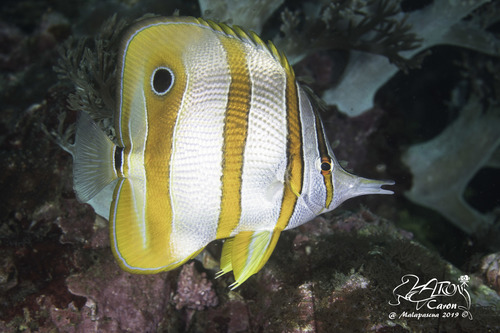
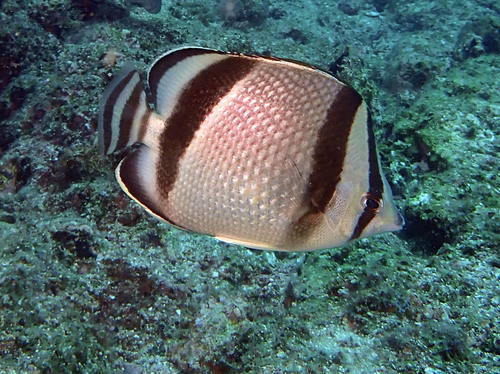
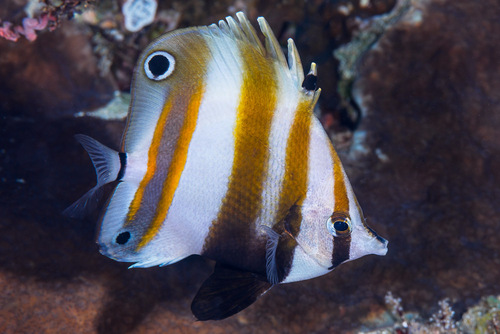
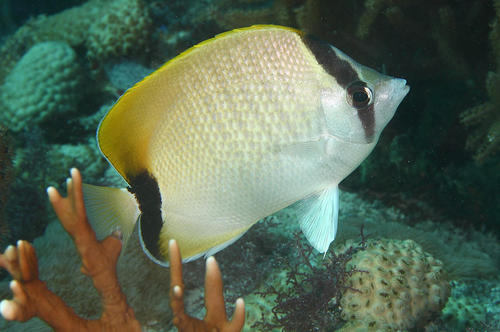
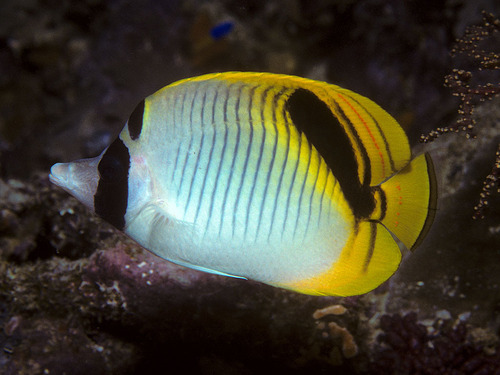
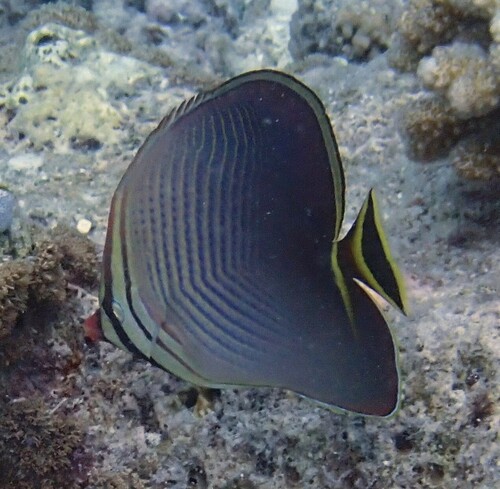
Chaetodon triangulum has a flat triangular body, a shape that is more noticeable when its fins are fully spread, and it also has an elongated snout. Its body is mostly whitish, marked with many broad, vertical grey chevron-shaped bands along its sides. The mouth is orange, and a brownish-orange vertical band runs through the eye. This band becomes brighter orange closer to the top of the head, and in adults it widens as it extends backward onto the base of the dorsal fin. Both the caudal peduncle and the caudal fin are black, with yellow margins on the caudal fin. The dorsal fin has 11–12 spines and 23–26 soft rays, while the anal fin has 3 spines and 20–21 soft rays. This species reaches a maximum total length of 16 centimetres (6.3 in).
Chaetodon triangulum has a wide distribution across the Indian Ocean, ranging from the coast of tropical East Africa east to the Andaman Sea, and along the Indian Ocean coastlines of Sumatra and Java. It also occurs at the Seribu Islands and has been recorded near Bali.
This species inhabits lagoons and seaward reefs, and it is strongly associated with corals of the genus Acropora, especially staghorn corals. It is a territorial species that lives in pairs; solitary juveniles hide among coral branches. Triangle butterflyfish are obligate corallivores, feeding primarily on Acropora corals. They defend patches of these corals, and actively chase other butterflyfishes away from their territories and their contained food supply.