About Chaetodon sedentarius Poey, 1860
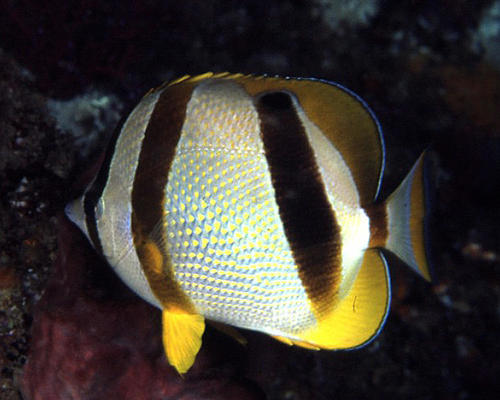
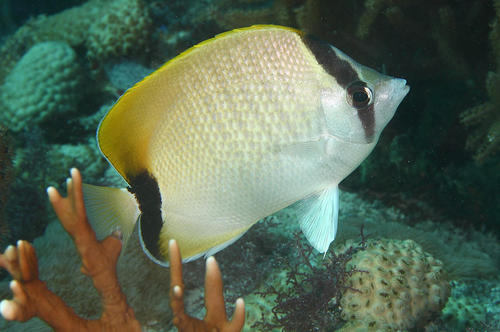
Chaetodon sedentarius, commonly known as the reef butterflyfish, has a strongly compressed, oval-shaped body that is more rectangular than other Western Atlantic butterflyfish species. It has a short, pointed snout that lacks cheekbones, with the mouth positioned at the tip of the snout. The upper body and upper head are yellow, fading to white on the belly and lower head. A vertical black bar passes through the eye, and a second vertical black bar runs along the rear edge of the body, as well as along the rear edges of the dorsal and anal fins. The remaining portions of the dorsal and anal fins, plus the caudal fin, are yellow. Juvenile reef butterflyfish have a less distinct rear black bar, which may only appear as two separate spots. The dorsal fin has 13 to 14 spines and 20 to 22 soft rays, while the anal fin contains 3 spines and 17 to 19 soft rays. This species reaches a maximum total length of 15 centimetres (5.9 in).
The reef butterflyfish is native to the warmer waters of the Western Atlantic Ocean, ranging north from São Paulo state to North Carolina, and including the Gulf of Mexico and Bermuda. It has been recorded around the Azores, but has not established permanent breeding populations there.
This species inhabits rocky and coral reefs down to depths of 60 metres (200 ft). Its compressed body shape lets it dart in and out of coral to forage, and its small, protractile mouth is an additional adaptation for finding food within coral structures. The mouth holds long, thin, flattened teeth that are slightly recurved at their tips. These teeth are used to scrape and nip at small invertebrates including polychaetes, shrimps, and amphipods. The species is also reported to feed on the eggs of the sergeant major (Abudefduf saxatilis). Reef butterflyfish are quite agile when feeding, often swimming upside down to reach prey hiding in crevices.
Adult reef butterflyfish are most often found in pairs, and they may be monogamous with strong pair bonds. Spawning occurs at dusk, after a long, energetic courtship that involves circling. The pair then swims upward and releases eggs and milt. Each female releases 3,000 to 4,000 eggs per spawning event. The small, transparent, pelagic eggs hatch within 24 hours, and newly hatched larvae are tiny, translucent, and silvery. Along with scats, butterflyfish larvae are unusual in being armoured, with bony plates covering the head and body; this armoured stage is called the tholichthys stage. The tholichthys stage continues until larvae reach 20 millimetres (0.79 in) in length, at which point they settle on the substrate at night. By the following day, they have developed into juveniles, which hide in crevices until they are large enough to be reasonably safe from predators, then emerge into shallow water next to channels or ledges.
Reef butterflyfish have many predators, mostly larger fish such as snappers, groupers, and moray eels. They normally flee when attacked, but if escape is not possible, they adopt a defensive posture: they face their pursuer with their head lowered and the spines in the dorsal fin fully raised.