About Chaetodon ornatissimus Cuvier, 1831
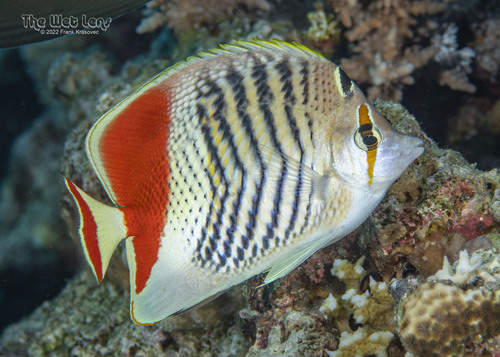
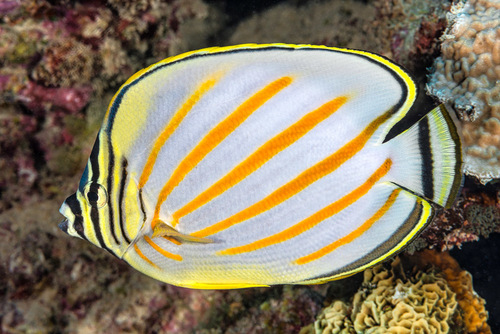
Morphology: Chaetodon ornatissimus, also called the ornate butterflyfish, is most easily identified by its color pattern, which helps protect it from predators. Ornate butterflyfish have white bodies with oblique orange to orange-brown bands. They also have two black bars with yellow edges on their head: one runs across the eye and the other sits on the snout, and the tail has two black bars. Total body length ranges from 13 to 18 cm, with a mean of 16.2 cm and a standard deviation of 1.4 cm; paired adult individuals are nearly always indistinguishable by size. Habitat and range: The ornate butterflyfish is widespread across the tropical waters of the Indo-Pacific region, ranging from Sri Lanka east to Hawaii, the Marquesas, and the Pitcairn Islands, north to southern Japan, and south to Lord Howe Island and Rapa in the Austral Islands. It is a marine, inshore, tropical reef-associated species found between 30°N and 30°S latitude, and 77°E to 124°W longitude. It typically inhabits depths from 1 to 36 meters. Over three-quarters of the world's fish species inhabit the Indo-Pacific region this species occupies. Habitat threats: Like other coral reef organisms, ornate butterflyfish face many natural and human-caused disruptions that are a major driver of their habitat loss. Sessile benthic communities on tropical coral reefs experience natural disturbances including tropical storms, unseasonal temperature extremes, and infestations of crown-of-thorn sea stars (Acanthaster planci). These events are becoming more frequent, making human-caused impacts more persistent. Anthropogenic disturbances include overfishing, pollution, and coastal development, all of which cause coral depletion. More than 30 percent of the world's coral reef communities have already been degraded, and it is projected that more than 60 percent of global coral reef communities will be lost by 2030. These changes to the structure of benthic coral reef habitats have harmful effects on coral reef fish, specifically butterflyfish. Multiple studies have documented butterflyfish population decline and localized extinctions following coral depletion. A study by Pratchett et al. found that declines in the abundance of Chaetodon butterflyfish were almost certainly linked to coral depletion, and these abundance declines were caused by starvation. Another harmful human-caused effect that alters habitat community composition is the shift from coral-dominated to seaweed-dominated benthic communities. Coral reef communities provide shelter and food resources for butterflyfish, but seaweed presence has a major impact on butterflyfish, as they actively avoid corals that are in contact with seaweed. Human-caused impacts including overfishing of herbivorous fish and increased eutrophication create favorable conditions for seaweed growth. The expansion of seaweed-dominated benthic communities limits the expansion of coral colonies and reduces the availability of surfaces for coral larval settlement and development. Reproduction: Ornate butterflyfish are monogamous, pair-forming coral reef fish, and many individuals mate for life. Spawning timing varies by biome: tropical populations have a spawning peak in winter and early spring, while temperate populations spawn in midsummer. Spawning occurs at dusk, and eggs are released and fertilized in the water column.