About Chaetodon miliaris Quoy & Gaimard, 1825
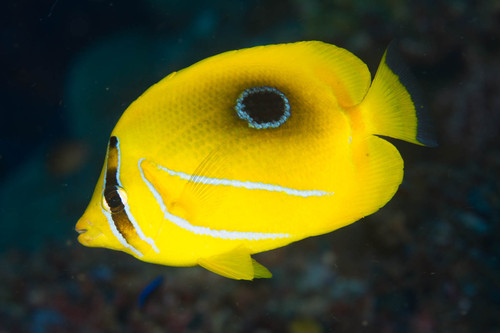
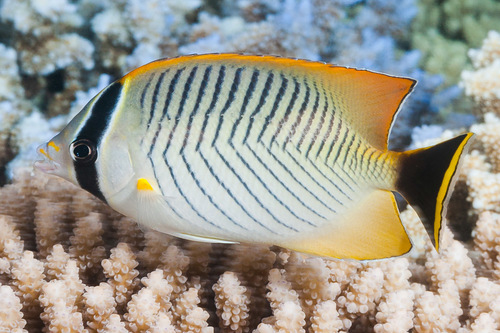
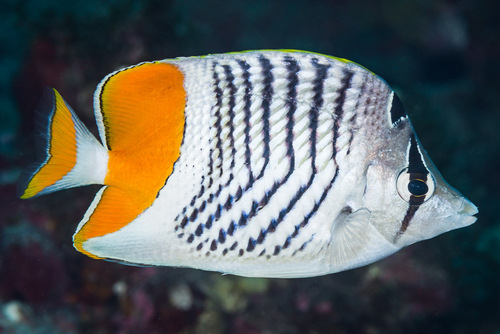
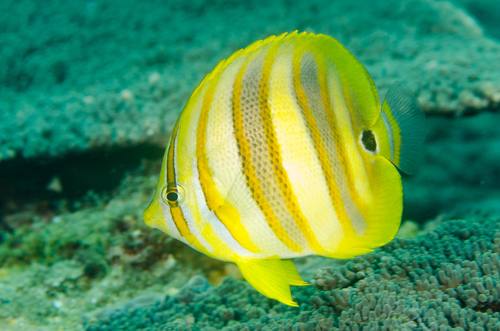
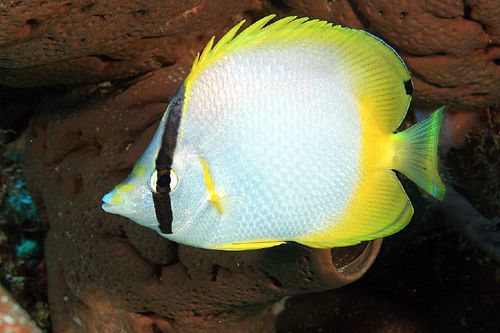
Chaetodon miliaris Quoy & Gaimard, 1825, commonly called the millet butterflyfish, reaches a maximum length of 13 centimeters (5 inches). It has a deep, laterally flattened body. Its dorsal fin contains 13 to 14 spines and 20 to 23 soft rays, while its anal fin has 2 to 3 spines and 17 to 20 soft rays. Its body is generally whitish or yellow, with multiple vertical rows of dark spots on the flanks. A wide black stripe extends from above the eye to the base of the operculum, and a large black patch is present on the caudal peduncle. This species is endemic to the Hawaiian Islands and Johnston Atoll, and occurs at depths down to at least 250 meters (820 feet). It inhabits coastal fringing reefs, outer reefs, and lagoons. The millet butterflyfish is a schooling, mid-water species that feeds on zooplankton. It also feeds opportunistically on polychaete worms and other small invertebrates on the seabed. It captures food by drawing it into the mouth with rapid suction. It does not appear to be territorial, instead forming feeding aggregations at specific reef sites. While its full breeding habits are not known, its gonads are large relative to its body size, which suggests it may have a promiscuous mating system. Breeding occurs between January and May, and newly settled juveniles are found in inner reef areas between April and June. This species is sometimes collected from the wild for the aquarium trade. Because of its feeding habits, it is more suitable for reef aquariums than more specialized coral-feeding butterflyfish that eat scleractinian corals. It is rare at Johnston Atoll, but plentiful around the Hawaiian Islands. The International Union for Conservation of Nature has determined that its overall population is stable, and wild collection has little impact on the species. As a result, the organization assesses its conservation status as least concern.