About Chaetodon humeralis Günther, 1860
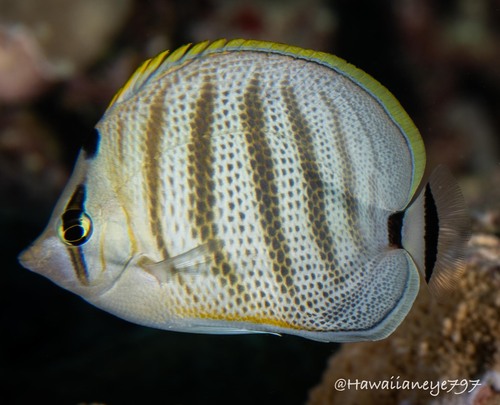
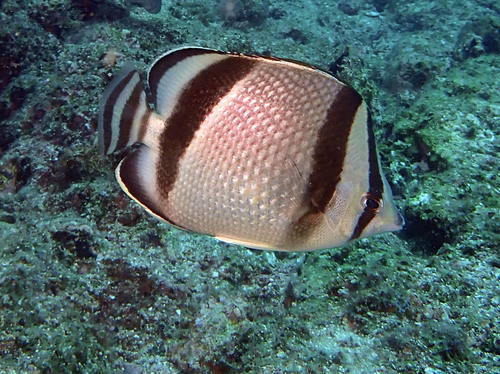
Chaetodon humeralis Günther, 1860 has an oval, disc-shaped body that is strongly compressed, with a small mouth positioned at the end of a short snout. Its body is white or silvery white, marked with distinct brownish-black bands: one along the line of the pectoral fin, a second running inward from the base of the caudal fin, and a third that runs from the nape down through the eye to the throat. All median fins have black bands running through them. The dorsal fin contains 12–13 spines and 18–20 soft rays, while the anal fin contains 3 spines and 15–17 soft rays. The maximum recorded total length of this species is 25.4 centimetres (10.0 in), though a length of 12 centimetres (4.7 in) is more typical. This species occurs in the Eastern Pacific Ocean. Its range extends south from its northernmost point of occurrence at Redondo Beach, Los Angeles, California, to Peru. It is also found around the Galapagos Islands (Ecuador), the Revillagigedo Islands (Mexico), Cocos Island (Costa Rica), and Malpelo Island (Colombia). Chaetodon humeralis is strongly associated with rock reefs, but has been recorded over a variety of substrates across different parts of its range, including intertidal pools, mangroves, and estuaries. It is normally found in pairs or small shoals, often close to shore, and will join mixed shoals with the Pacific spadefish (Chaetodipterus zonatus). It forms pairs to spawn, laying pelagic eggs. It feeds on benthic invertebrates and algae. Its depth range is 2 to 55 metres (6.6 to 180.4 ft), but it is most common between 3 and 12 metres (9.8 and 39.4 ft).