About Chaetodon guentheri Ahl, 1923
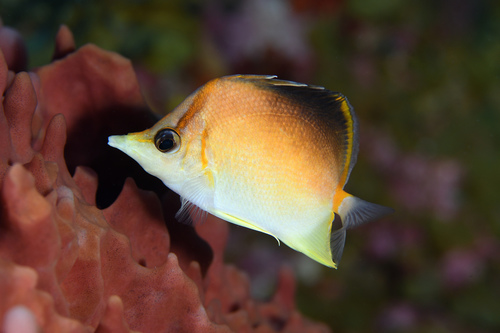
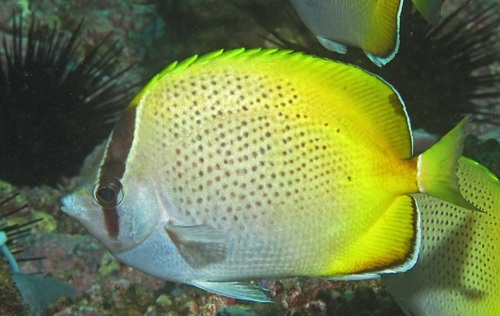
Chaetodon guentheri, commonly known as Gunther's butterflyfish, has a body that is primarily white to pale yellow, marked with small dark spots that form irregular lines. The background body color is whitest near the head, gradually becoming yellow toward the back and tail. The posterior portion of the body, the soft-rayed section of the dorsal fin, and the anal fin are all yellow. A vertical black bar passes through the eye. Both the dorsal and anal fins have a white marginal band, with a thin black band positioned just inside this white margin. The dorsal fin has 13 spines and 21 to 22 soft rays, while the anal fin has 3 spines and 18 soft rays. This species reaches a maximum total length of 18 centimetres (7.1 in). This species is endemic to the Western Pacific Ocean. Its distribution extends from southern Japan and Taiwan in the north, southward to New South Wales, Australia. It can also be found off Lord Howe Island, along the Great Barrier Reef, and as far east as Tonga. Gunther's butterflyfish inhabits seaward reefs with dense coral growth, occurring at water depths between 5 and 50 metres (16 to 164 ft). It is typically solitary, but will form schools when making longer movements, particularly in areas with strong currents. It is most often found in regions with sponge growth; it prefers deeper water in tropical sponge-growing areas, and can be found at shallower depths in temperate regions. This species swims through open water, and is known to clean large pelagic fishes. It is an oviparous species, where males and females form breeding pairs. Its diet includes plankton, as well as soft and stony coral polyps, sea anemones, sponges, worms, tunicates, crustaceans, and other benthic invertebrates.