About Chaetodon fremblii Bennett, 1828
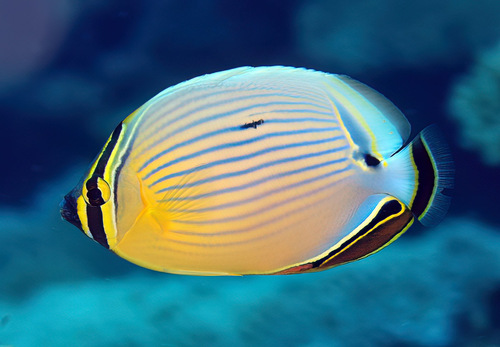
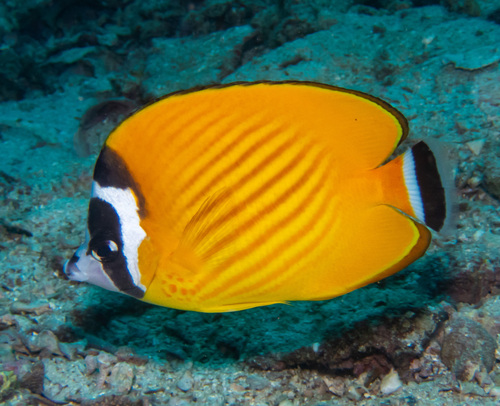
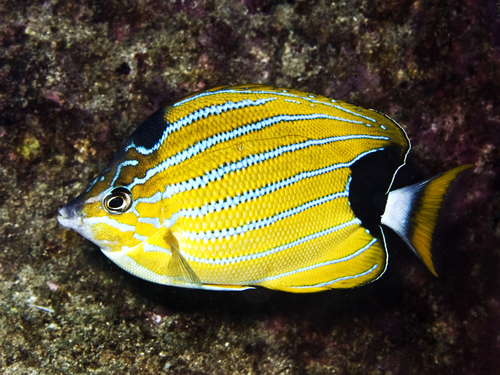
Description: Bluestripe butterflyfish, like other butterflyfish, are laterally flattened fish with pointed snouts and rectangular bodies, reaching a maximum length of 15 cm (6 in). The dorsal fin has 12 to 14 spines and 20 to 21 soft rays, while the anal fin has 3 spines and 16 to 18 soft rays. The species has a yellow body background marked with eight distinct diagonal blue stripes that radiate outward from the area around the eye. It has a black spot at the top of the head, and a larger black spot at the base of the tail. This larger dark patch may function to distract predators, encouraging them to attack the fish’s tail instead of its head. Distribution: Bluestripe butterflyfish is endemic to the Hawaiian Islands, where it is abundant on coral and rocky reefs at depths down to approximately 28 m (90 ft). Ecology: Bluestripe butterflyfish is an omnivore, which differs from some other butterflyfish species that feed almost exclusively on corals. Most of these coral-feeding specialist butterflyfish have mating systems centered on pair bonds. In contrast, the omnivorous bluestripe butterflyfish lives in a more resource-rich environment, where finding enough food is easier. Because of this, males of bluestripe butterflyfish use a harem mating system, where a male defends a territory that contains up to four smaller female territories.