About Chaetodon flavirostris Günther, 1874
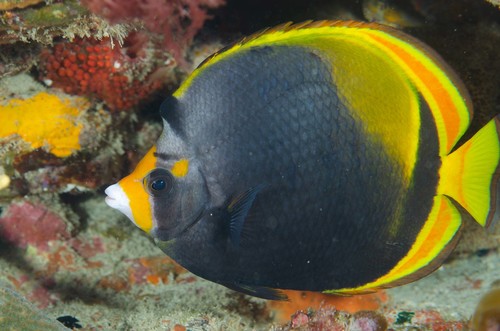
Chaetodon flavirostris, commonly called the black butterflyfish, has a dark bluish-grey body, with a distinctively white mouth and a narrow yellow band on its snout. It has a darker prominent bump on the forehead. The dorsal, anal, and caudal fins are yellow. An orange band runs across the dorsal and anal fins and the caudal peduncle; these fins and the tail have black margins. Juveniles have paler grey bodies and yellow median fins. The dorsal fin contains 12 to 13 spines and 24 to 27 soft rays, while the anal fin has 3 spines and 20 to 21 soft rays. This species reaches a maximum total length of 20 centimetres (7.9 in).
The black butterflyfish is distributed across the southern Pacific Ocean, ranging from the Great Barrier Reef and New South Wales, and Lord Howe Island east as far as Easter Island. It has been recorded at American Samoa, the Cook Islands, Fiji, French Polynesia, New Caledonia, Niue, Norfolk Island, Pitcairn Island, Samoa, the Solomon Islands, Tonga, Vanuatu, and Wallis and Futuna. The Easter Island record is considered to be of a vagrant individual. It is also found in the Indian Ocean at the Cocos (Keeling) Islands.
This species occurs at depths between 2 and 20 metres (6.6 to 65.6 ft). It inhabits rocky areas with thick coral and algae coverage, found in both lagoons and on seaward reefs, and can also occur in estuaries. It is an omnivorous species that feeds on algae, coral, and small benthic invertebrates. Black butterflyfish are oviparous, they live and breed in pairs, though aggregations have been observed in some regions. Juveniles occupy protected inner reef habitats.