About Chaetodon falcula Bloch, 1795
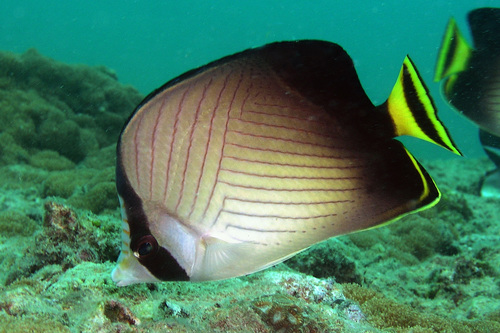
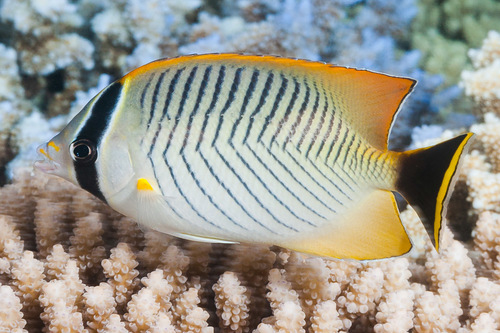
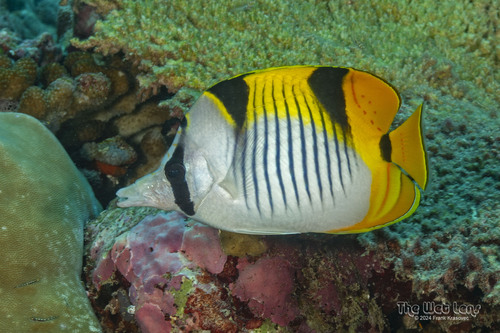
Chaetodon falcula, formally described by Bloch in 1795, has a white body marked with multiple thin vertical dark grey lines. It has two distinct black saddle-shaped blotches on the upper part of its body, a vertical black band across its eye, and a black caudal peduncle. The dorsal, anal, and caudal fins are yellow; this yellow color extends onto the body adjacent to the dorsal and anal fins. Its dorsal fin has 12–13 spines and 23–25 soft rays, while its anal fin contains 3 spines and 20–21 soft rays. This species reaches a maximum total length of 20 centimetres (7.9 in).
This species is distributed across the Indian Ocean. Its range extends along the East African coast from Kenya to South Africa, includes Madagascar and other western and central Indian Ocean islands, and covers Sri Lanka, southern India (including the Andaman and Nicobar Islands), and waters from western Thailand east to Java. It is also found at the Cocos (Keeling) Islands, which are part of Australia.
Chaetodon falcula occurs at depths between 1 and 15 metres (3.3 to 49.2 ft). It is typically found on reef edges and upper slopes, usually in habitats exposed to strong currents. Juveniles of this species hide among corals. Adults are most often seen in pairs or small aggregations of up to 20 individuals. Its diet consists of coral polyps, worms, sea anemones, crustaceans, sponges, sea urchin tube feet, and other invertebrates. This species forms distinct breeding pairs, and it scatters pelagic eggs into open water.