About Chaetodon ephippium Cuvier, 1831
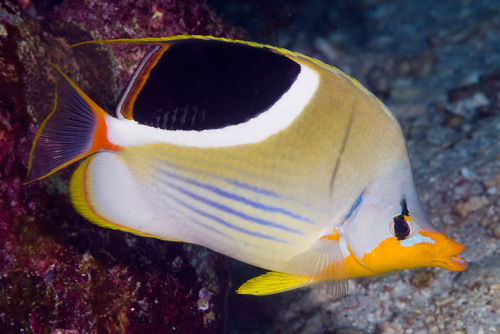
The saddle butterflyfish (Chaetodon ephippium Cuvier, 1831) is a species of marine ray-finned butterflyfish that belongs to the family Chaetodontidae. This species occurs in the Indian and Pacific Oceans, ranging from Sri Lanka and the Cocos-Keeling Islands to the Hawaiian, Marquesan, and Tuamotu islands. Its distribution extends north to southern Japan, and south to Rowley Shoals and New South Wales in Australia. Saddle butterflyfish are among the largest members of their genus, reaching up to 30 centimeters, or nearly 12 inches, in length, sharing this status with the Lined Butterflyfish (C. lineolatus). In terms of body shape, it resembles certain angelfishes more closely than most other butterflyfish relatives. Its overall body color is yellowish grey, with a large black spot on its back that is bordered below by a broad white band, and wavy blue lines on its lower sides. Its throat and the outline of its hind body parts are bright yellow. Adult individuals have a filament that extends backward from the upper section of the soft portion of the dorsal fin. This species lives on coral reefs at depths between 0 and 30 meters. It feeds on filamentous algae, small invertebrates, coral polyps, and fish eggs. The saddle butterflyfish was first formally described in 1831 by French anatomist Georges Cuvier, who lived from 1769 to 1832. Its type locality was recorded as Bora Bora, located in the Society Islands, which is part of French Polynesia. It is classified within the large subgenus Rabdophorus, which some research suggests may deserve recognition as a separate genus. Within this group, the saddle butterflyfish appears to form its own distinct lineage. The dotted butterflyfish (C. semeion) is likely the only species that is somewhat closely related to it. The next closest relatives are a group that includes the blackback butterflyfish (C. melannotus), spot-tailed butterflyfish (C. ocellicaudus), and yellow-dotted butterflyfish (C. selene), but these lineages are already very distant. Their ancestors diverged from the saddle butterflyfish's lineage soon after the Rabdophorus lineage first began to diversify.