About Chaetodon decussatus Cuvier, 1829
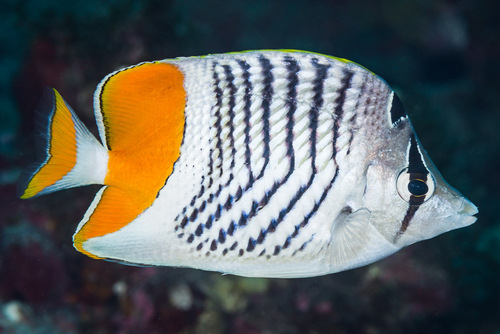
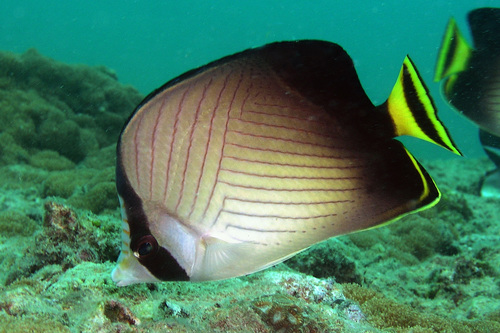
The Indian vagabond butterflyfish (Chaetodon decussatus), also called the blackened butterflyfish or black-finned vagabond, is a species of marine ray-finned butterflyfish that belongs to the family Chaetodontidae. It occurs in the Indo-West Pacific, ranging from the Maldives, through India, Sri Lanka, and the Andaman Sea, to the westernmost part of the Indonesian archipelago. This species has a silvery-white body marked with diagonal grey lines, plus a broad black vertical band that runs through its eyes. The lower posterior section of its body is mostly black, and yellow markings appear on its tail and anal fins. It reaches a maximum length of 20 cm, which is nearly 8 inches. It inhabits coral-rich reefs, as well as rubble and rocky areas. Adult Indian vagabond butterflyfish are monogamous, swim in pairs, and may be territorial and aggressive toward other Chaetodon species, while juveniles live solitarily. This fish feeds mainly on algae and coral polyps, and it is oviparous. The species was first formally described in 1829 by French anatomist Georges Cuvier (1769–1832), with its type locality given as "India". It belongs to the large subgenus Rabdophorus, which may deserve recognition as a separate genus. Within this group, it is almost certainly a close relative of the threadfin butterflyfish (C. auriga) and the vagabond butterflyfish (C. vagabundus). It is possible that C. decussatus is more closely related to the threadfin butterflyfish than to the common vagabond butterflyfish, but this is difficult to confirm because C. vagabundus has produced abnormal DNA sequence data. The C. auriga species group shares the characteristic pattern of two sets of ascending and descending oblique lines, but its species differ noticeably in the coloration of their hindquarters.