About Chaetodon capistratus Linnaeus, 1758
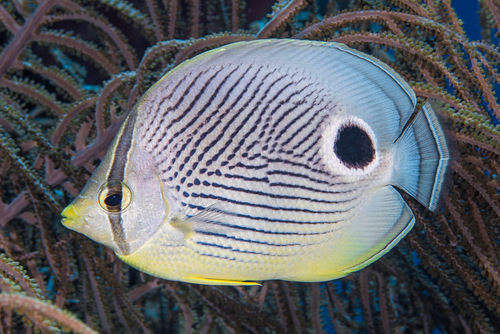
Chaetodon capistratus, commonly called the foureye butterflyfish, has a deep-bodied, laterally compressed shape, a single dorsal fin, and a small mouth lined with tiny bristle-like teeth. Its body is light grey, sometimes with a yellowish tint, and marked with dark forward-pointing chevrons, and its ventral fins are yellow. The species gets its common name from a large dark spot on the rear portion of each side of its body; this spot is surrounded by a bright white ring that resembles an eye. A black vertical bar on the head runs through the fish's true eye, making the real eye hard to see. This pattern can confuse predators into mistaking the back end of the fish for the front end. When threatened, the foureye butterflyfish's first instinct is to flee, which places the false eye spot closer to the predator than the actual head. Most predators target eyes, so this false eye spot acts as automimicry that tricks predators into expecting the fish to flee tail-first. The eye spot also has other hypothesized potential functions. It is larger and more variable in shape than the real eye: it is vertically oval in young fish and becomes more circular in adults. These features suggest other possible functions for the eye spot: intimidating prey, changing predation reaction distances, disorienting predators, acting as a general warning, or enabling social communication. If escape is not possible, a foureye butterflyfish will sometimes turn to face its aggressor, with its head lowered and all spines fully erect, similar to a bull about to charge. This display may intimidate the other animal, or remind the predator that the butterflyfish is too spiny to be an easy meal. Foureye butterflyfish typically live in shallow inshore waters, where they feed on a range of invertebrates, mainly zoantharians, sea anemones, scleractinians, polychaete worms, gorgonians, tunicates, crustaceans, and fish eggs. This fish is known for its remarkable ability to swim in and around coral heads and reefs; it can navigate even the most intricate passages by swimming on its side or even upside down. Like related butterflyfish species, foureye butterflyfish mate for life, so they are most often seen in pairs. They are one of the few fish species that mates for life.