About Chaetodon auriga Forsskål, 1775
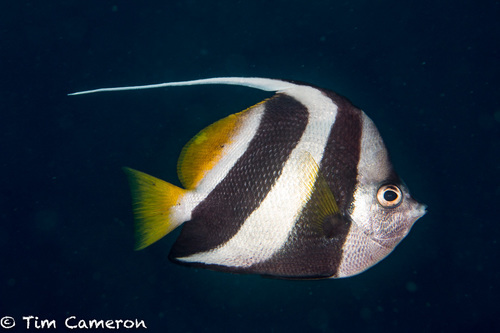
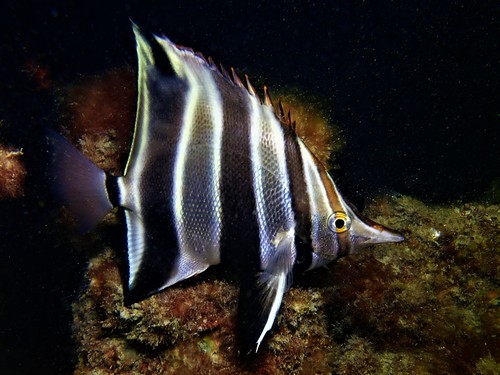
Chaetodon auriga, first formally described by Forsskål in 1775, reaches a maximum length of 23 centimetres (9 inches). Its body is white, with chevron-shaped markings along its sides. A distinct black vertical band runs through its eye, and the rear edge of its dorsal fin bears a prominent black spot, with a trailing filament extending from behind the spot. This species also has a patch of descending oblique dark lines on its belly, and all its fins are bright yellow. Two subspecies are sometimes recognized for this species: Chaetodon auriga auriga, which occurs in the Red Sea and lacks the black dorsal eyespot; and Chaetodon auriga setifer, the spotted population found outside the Red Sea. Chaetodon auriga is native to the Indo-Pacific region, where it occurs from the Red Sea and eastern Africa, south as far as Mossel Bay, South Africa, east to the Hawaiian, Marquesas, and Ducie islands, north to southern Japan, and south to Lord Howe Island and Rapa Iti. It inhabits waters at depths between 1 and 35 metres (3 to 115 feet). A single individual of this species was recorded in 2015 in the western Mediterranean Sea off the coast of Italy, and this record is likely the result of an aquarium release.