About Chaetodon aureofasciatus Macleay, 1878
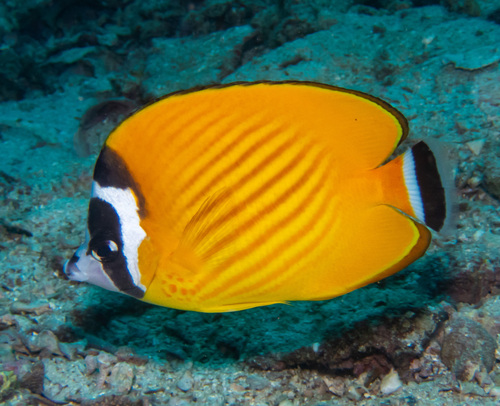
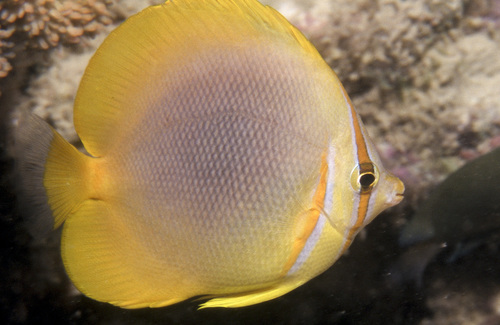
Chaetodon aureofasciatus Macleay, 1878 has a whitish body cross-hatched with darker lines, which creates an overall purple hue. Its caudal, anal, dorsal, and pelvic fins are yellow. A black-edged orange vertical band runs through the eye, and an additional thin vertical orange band sits just behind the head, on the head region. The dorsal fin contains 11 spines and 20–22 soft rays, while the anal fin has 3 spines and 17–18 soft rays. This species reaches a maximum total length of 12.5 centimetres (4.9 in).
Chaetodon aureofasciatus is native to the southwestern Pacific Ocean. Its range covers northern Australia, where it occurs from Coral Bay in Western Australia to Moreton Bay in Queensland. It is also found in southern Papua New Guinea.
This species inhabits coastal and offshore reefs, and is frequently found on silty coastal reefs, including those located near river mouths. It can tolerate high levels of freshwater, and occurs at depths of 1 to 20 metres (3.3 to 65.6 ft). Individuals are typically found as pairs or in small groups. Chaetodon aureofasciatus is an obligate corallivore that feeds on coral polyps, but it can survive in areas with relatively sparse coral growth. Observations show that this species appears to have developed a broader diet than other corallivorous butterflyfishes, which may be a response to coral declines. This dietary shift may also explain the species' movement into brackish water.
Chaetodon aureofasciatus is occasionally collected for the aquarium trade, but it is considered difficult to maintain in captivity.