About Chaetodipus californicus (Merriam, 1889)
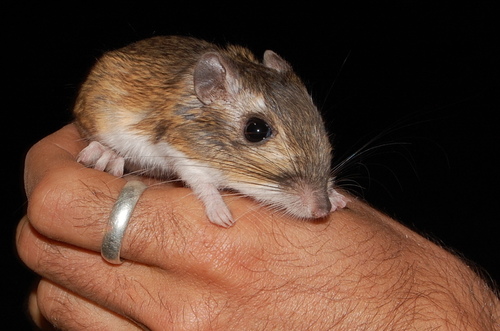
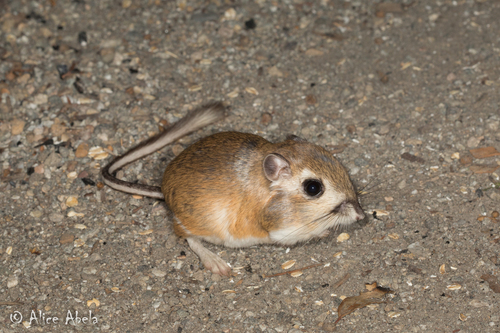
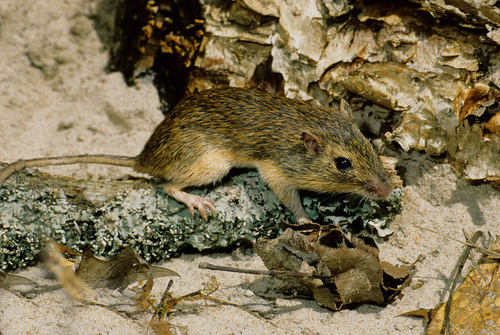
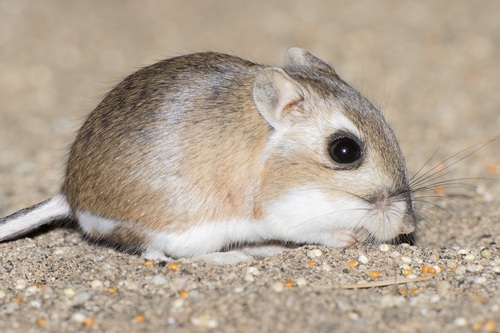
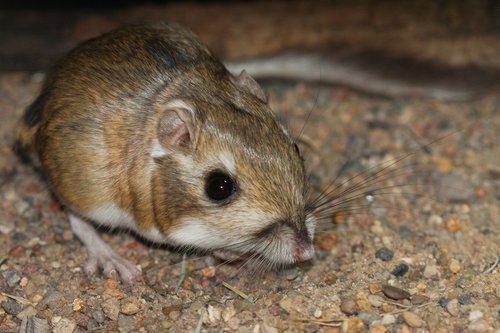
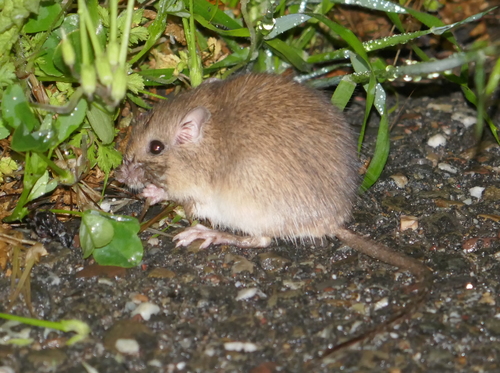
Chaetodipus californicus, commonly known as the California pocket mouse, has a dental formula of (1.0.1.3 / 1.0.1.3) × 2, totaling 20 teeth. Its upper fur is brown, and its underfur is tan, with distinct white hairs or spines located near the rump. The tail is dark on the upper side, light on the underside, and has a tuft at the tip. Females and males are approximately the same size, with no observed sexual dimorphism. This species is often confused with C. fallax, the San Diego pocket mouse, which shares some of the same habitat but has smaller, rounder ears. The total body and tail length of C. californicus ranges from 190 to 235 mm, the tail alone measures 102 to 143 mm, and body weight ranges from 18 to 29 grams. C. californicus is native to California in the western United States and northern Baja California state in northwestern Mexico. It occurs in habitats including California chaparral and woodlands, across Southern California in the Southern Sierra Nevada, Southern California Coast Ranges, and Transverse Ranges; it also occurs in the Peninsular Ranges of Southern California and northern Baja California. Eight recognized subspecies of C. californicus are found across its native range: C. c. californicus, C. c. femoralis, C. c. dispar, C. c. mesopolius, C. c. ochrus, C. c. bernandinus, C. c. bensoni, and C. c. merinensis. These subspecies have been recorded near Berkeley in Alameda County; Dulzura in San Diego County; Carpenteria in Santa Barbara County; Sierra San Pedro Martir in Baja California; Santiago Springs in Kern County; the San Bernardino Mountains in San Bernardino County; Soledad in Monterey County; and Indian Harbor in Monterey County. The distribution boundaries of southern subspecies are less well-documented than those of northern subspecies. Although C. californicus is relatively widespread across most of central and southern California, the species' known habitat is shrinking due to climate change and human activities such as residential development.