About Chaetodipterus faber (Broussonet, 1782)
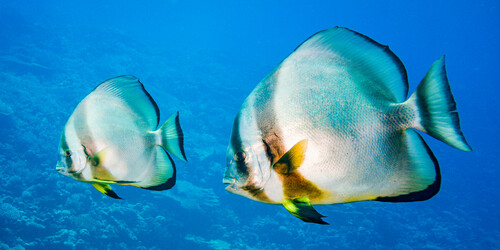
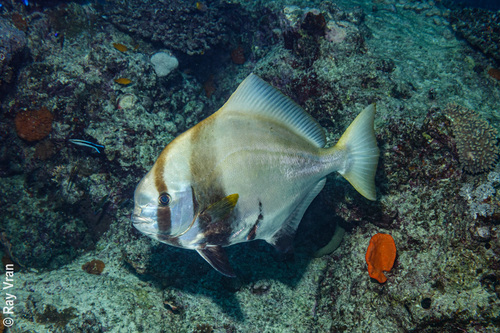
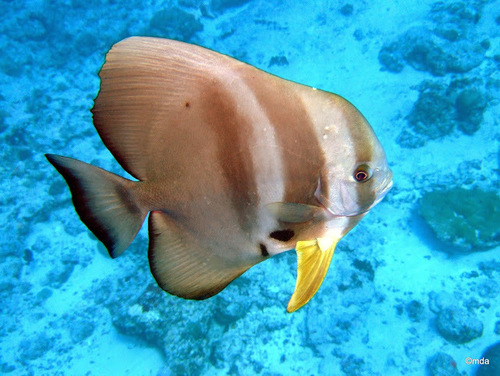
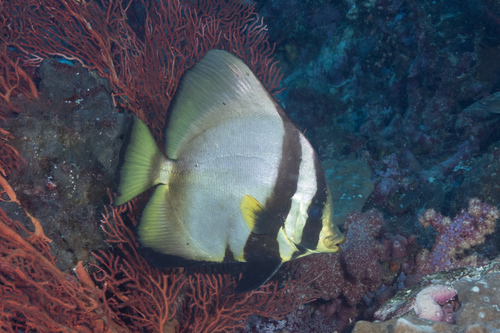
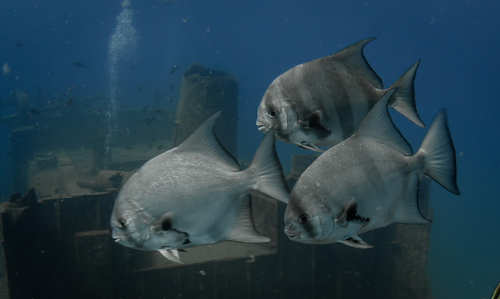
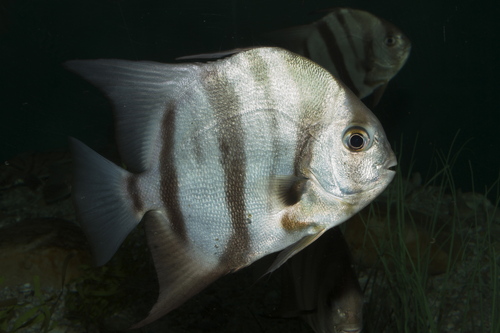
Chaetodipterus faber has a very deep, compressed, disk-shaped body and a blunt snout. Its fin structure includes 9 dorsal spines, 21–24 soft dorsal rays, 3 anal spines, and 17–19 anal rays. Adult individuals have long, trailing anterior lobes on their second dorsal and anal fins, which gives the species an angelfish-like appearance. The body is silver, marked with 4–6 irregular black vertical bands on each side that fade gradually as the fish ages. The first of these bands runs through the eye, while the last runs through the caudal peduncle. This species has a small mouth: in adults, the maxilla ends beneath the nostrils. The teeth are small and brushlike, and no teeth grow on the roof of the mouth. Both the head and fins are covered in ctenoid scales. Most specimens weigh between 3 and 10 pounds (1.4 to 4.5 kg), though individuals up to 20 pounds (9.1 kg) have been recorded. The species reaches a maximum total length of about 36 inches (91 cm). This species is endemic to the western Atlantic Ocean. It occurs off the southeastern coast of the United States as far north as Massachusetts, throughout the Gulf of Mexico and the Caribbean, as well as around Bermuda and along the eastern coast of Brazil. It lives in marine and brackish subtropical waters, and is most common in shallow coastal waters between 3 and 35 metres (9.8–114.8 ft) deep. Juveniles typically stay in estuaries until they reach maturity, while adults favor mangroves, beaches, and harbors. The spawning season for Chaetodipterus faber runs from May to September. A single female can release up to one million eggs each spawning season. Eggs hatch after 24 hours, and newly hatched larvae survive off their yolk for two days before beginning to actively feed.