About Chaetocoelopa littoralis (Hutton, 1881)
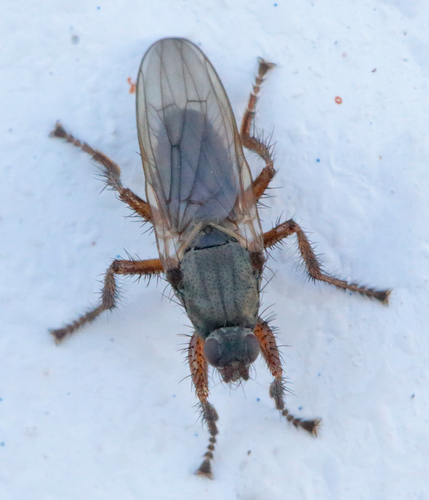
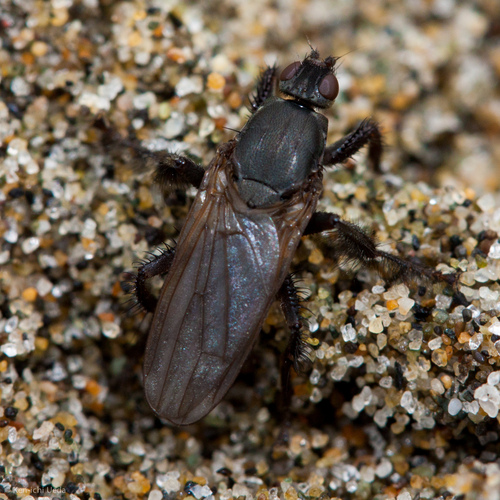
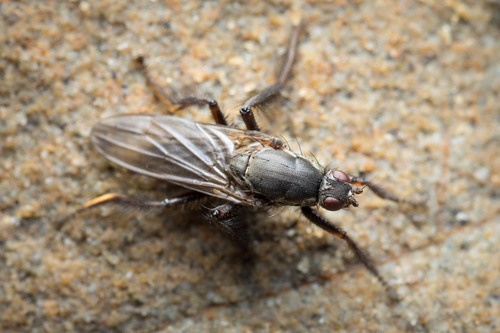
Chaetocoelopa littoralis (Hutton, 1881) is a small fly with long hairy legs, reaching an approximate body length of 7 mm. This species can walk on the surface of water, and can survive and recover after being inundated by waves. Hutton's original description of the species is as follows: The fly is overall grey, with a broad band on the head that stretches upward on each side of the ocelli. The antennae, palpi, proboscis, and legs are reddish-brown. The legs and abdomen bear long black hairs, while the thorax has short black hairs. The wings are hyaline with brown veins. This species is endemic to New Zealand, found along the entire New Zealand coastline including offshore islands. A study of coastal Diptera at 109 sites across the New Zealand coastline recorded C. littoralis at 41% of the sampled locations. Like other members of the family Coelopidae, C. littoralis lives in beds of decaying seaweed and kelp (called wrack) that have washed up on the coast, and can form large aggregations. It can also be seen resting in large aggregations on other surfaces including cliff faces and driftwood. The larvae of C. littoralis play an important role in helping decompose rotting seaweed on the shoreline. Both adult and larval C. littoralis are a significant food source for shore birds such as the New Zealand dotterel (Charadrius obscurus) and the New Zealand pipit (Anthus novaeseelandiae). Studies of the mating behaviour of C. littoralis show that, like other coelopids, larger males have greater mating success. This is because larger males are more able to overcome the typical female resistance behaviours during mating. Adult flies mate within wrack beds, and females lay their eggs onto the wrack. The larvae feed on decaying algae and the associated microorganisms, and go through three developmental instar stages before pupating on sand further up the beach.