About Ceyx erithaca erithaca
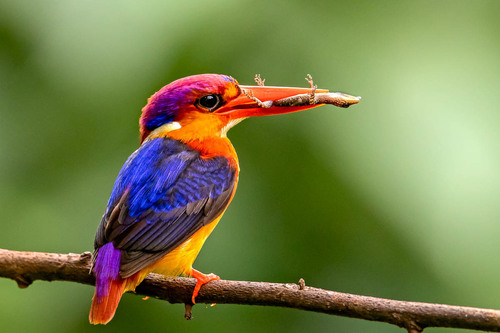
The black-backed dwarf kingfisher (Ceyx erithaca erithaca) is one of the smallest known kingfisher species. It is only slightly larger than a medium-sized hummingbird, with a total length (including bill and tail) of 12.5–14 cm (4.9–5.5 in). Females usually weigh 14–16g, while males weigh 14–21.5g, making males slightly larger on average. Aside from size, the two sexes are identical in appearance, with no other sexual dimorphism. Both adult males and females share the same plumage and physical features: a black spot on the forehead, blue and white patches on the side of the neck, a lilac-rufous crown, rump, and tail, dark blue back and wings, a white chin and throat, pale yellow-orange underparts, a dark brown iris, and red legs, feet, and bill. Juvenile black-backed dwarf kingfishers have duller coloration with less lilac marking, a white chin, throat and belly, a yellow-orange bill with a pale tip, and blue scapulars and wing-coverts. This species has three toes, which is why it is sometimes called the three-toed kingfisher, though multiple other kingfisher species also have three toes. The toe count in these kingfishers does not appear to be an adaptive trait. Its vocalization is a high-pitched, shrill "tsriet-tsriet" or soft "tjie-tjie-tjie" given in flight. The black-backed dwarf kingfisher is a forest and wetland species endemic to parts of the Indian subcontinent and Mainland Southeast Asia. Its breeding range covers eastern Bangladesh, northeastern India, Myanmar, extreme southern China, Laos, Cambodia and Thailand. A separate disjunct population lives in the Western Ghats of western India and in Sri Lanka. In winter, some individuals migrate south to the Malay Peninsula and Sumatra. The species is most often found in deciduous and evergreen primary and secondary forests, but also occurs in alluvial forests, mangroves, overgrown rubber gardens, and dense stands of palms, bamboos, or shrubs. Black-backed dwarf kingfishers tend to stay close to forest streams and ponds, but their nests are often located well away from water. They remain low to the ground, perching and flying within 1–2m of the forest floor. Their preferred habitat is densely shaded lowland forest near small streams or ponds, and the lowlands they occupy generally do not exceed 1000–1300m in elevation. The diet of the black-backed dwarf kingfisher consists primarily of insects, including mantises, grasshoppers, flies, water beetles, winged ants, and mayflies. It also eats spiders, oligochaete worms, small crabs, fish, frogs and lizards. Black-backed dwarf kingfishers forage alone, perching on low vegetation or rocks before flying out to capture prey from the ground or among foliage. They can take spiders directly from their webs and catch insects mid-flight. They also dive into water to catch prey at or just below the surface, without fully submerging themselves. Larger prey is typically carried back to a perch, where the bird strikes it repeatedly with its beak before swallowing it.