About Ceuthmochares aereus (Vieillot, 1817)
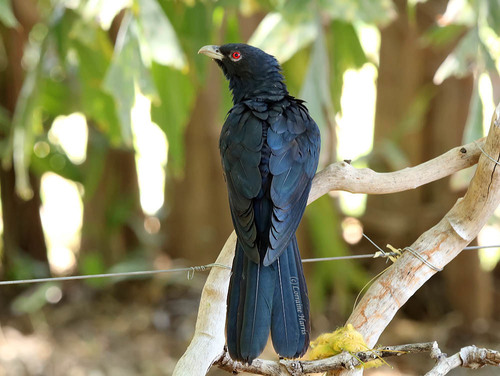
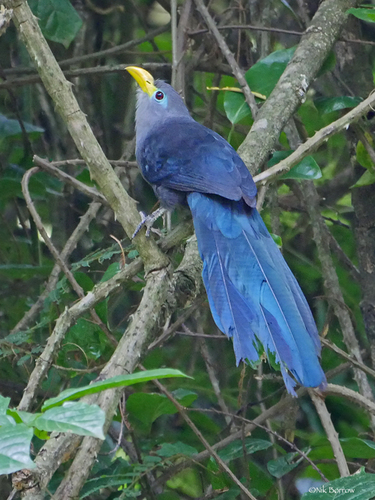
Ceuthmochares aereus, commonly called the blue malkoha, has a greyish belly, head, and throat, along with a heavy yellow bill. Different subspecies show small differences in plumage coloration: the nominate subspecies C. aereus aereus has greenish and blue tail, wings, and back, while C. aereus flavirostris has entirely blue tail, wings, and back. The blue malkoha feeds primarily on insects, especially caterpillars, beetles, grasshoppers, and crickets; it also eats frogs, slugs, fruit, seeds, and leaves. It travels through dense tangled vegetation by making a series of small hops, snatching prey as it moves. It will accompany other birds and squirrels, feeding on insects that these animals flush out into the open. Unlike many other cuckoo species, the blue malkoha is not a brood parasite, and instead cares for its own young after laying eggs. It lays two white and creamy eggs in a rough stick nest that is suspended 2 to 5 meters above the ground. Both parent birds share care for the young after hatching. The blue malkoha is an uncommon species that is rarely observed due to its secretive behaviour. Despite this, it is not considered threatened, and the IUCN currently lists it as a species of least concern.