About Cetraria aculeata (Schreb.) Fr.
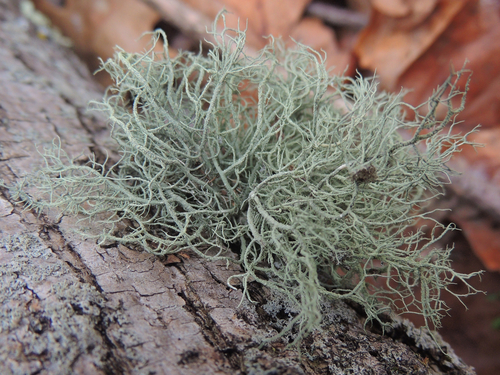
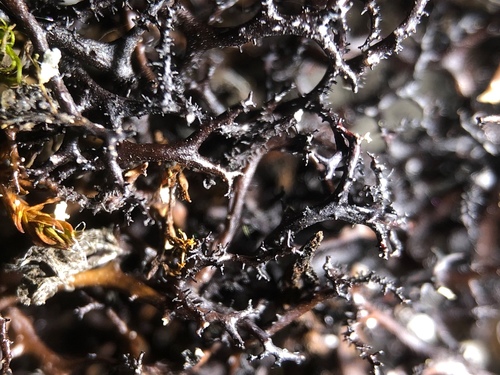
Cetraria aculeata, commonly called the spiny Iceland lichen, is a dark brown to black fruticose soil lichen belonging to the family Parmeliaceae. German naturalist Johann Christian Daniel Edler von Schreber first formally described this species in 1771, under the name Lichen aculeatus. Later, Erik Acharius, known as the "father of lichenology", reclassified it as Cornicularia aculeata, a name that was subsequently changed to Coelocaulon aculeatum. A later taxonomic revision by Ingvar Kärnefelt and colleagues moved the species to the genus Cetraria, giving it its current accepted name. The thalli of Cetraria aculeata form shrubby tufts that reach 1–5 cm in height. Its main branches measure 1 to 4 mm wide, while its terminal branches grow up to 1 mm wide. Results for both K and P chemical spot tests are negative for this species. This species is commonly found in a fertile state, and appears to propagate mainly through thallus fragmentation. Despite often lacking long-distance-dispersed ascospores, Cetraria aculeata has an extremely wide distribution. It is common in open polar and boreal environments, ranging from maritime Antarctica to the high Arctic. At intermediate latitudes, it occurs mostly in high mountain ecosystems; its range also extends into forest gaps, woodland and steppe ecosystems, and coastal and riparian sand deposits in Mediterranean and temperate zones. Several morphologically very similar, genetically closely related species are grouped together under the name Cetraria aculeata complex. This complex contains up to six distinct species: C. muricata, C. crespoae, C. steppae, C. odontella, C. australiensis, and the as-yet-unpublished C. panamericana. This grouping exists because these are cryptic species, a phenomenon documented for many groups of organisms. Cetraria aculeata is a known host for a number of lichenicolous fungus species, including Lichenopeltella cetrariicola, Acremonium lichenicola, Clypeococcum cetrariae, Didymocyrtis cladoniicola, Didymocyrtis trassii, Endococcus parmeliarum, Lichenoconium eroden, Eonema pyriforme, Katherinomyces cetrariae, Sphaerellothecium aculeatae, and Taeniolella rolfii.