About Cetoscarus ocellatus (Valenciennes, 1840)
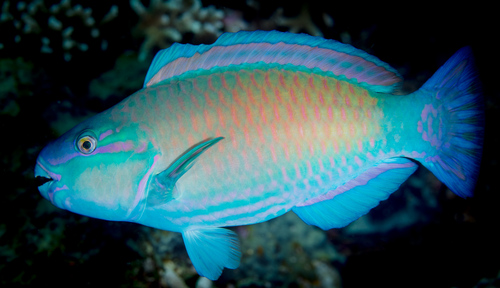
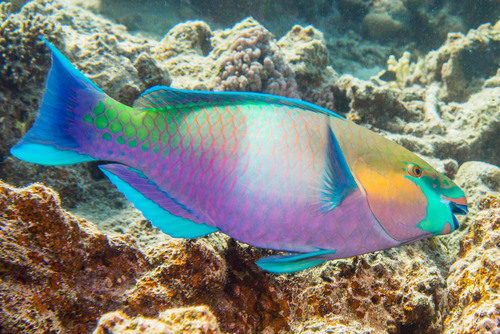
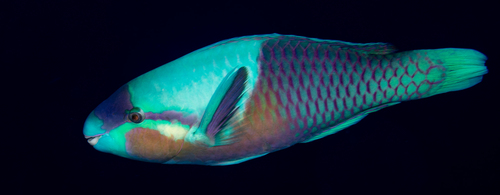
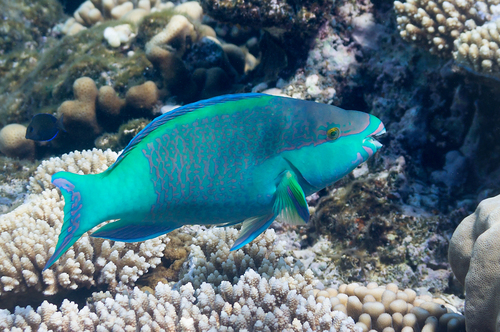
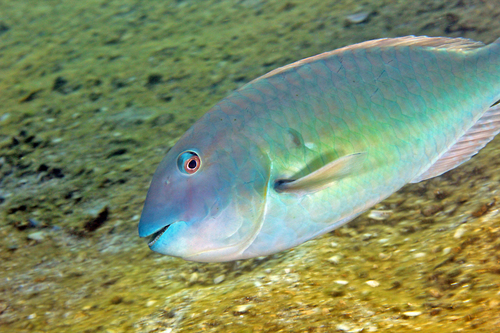
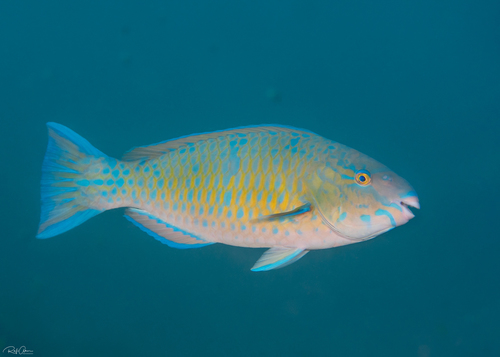
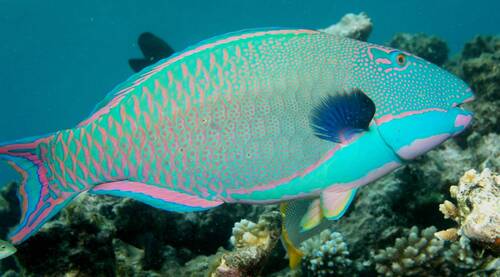
Cetoscarus ocellatus reaches a mature body length of approximately 30 to 80 cm (12 to 31 inches). This species has a long snout, with 14 to 15 pectoral rays, 5 to 7 median predorsal scales, and 3 rows of scales on the cheek. Its coloration differs by sex, and also between adult and juvenile individuals. Juveniles are typically white, with a thick orange band surrounding the head that excludes the snout and chin. They have a circular black spot on the dorsal fin, and a thick orange band on their rounded tail. Initial-phase females have a dark purple to reddish brown head, with fine black spotting on the ventral side. Their body has a broad pale yellowish zone along the dorsal side, and is bluish gray below this zone. Their scales are rimmed and spotted with black. Their median fins are brownish red, and the caudal fin has a whitish crescent along its posterior edge. Brightly colored terminal-phase males are green, with scales rimmed in pink. The head and anterior part of the body have numerous small pink spots, and an orange line runs from the mouth to the anal fin. Cetoscarus ocellatus is widespread in the coastal waters of the Indian and Pacific Oceans. It occurs along the southeastern coast of Africa from Somalia to South Africa, in Australia, in Southeast Asia's Coral Triangle region, and as far north as southern Japan. This species is associated with coral reefs, and can be found at depths ranging from 1 to 40 m (3.3 to 131.2 ft). Different individuals occupy different habitats: some prefer coral reefs, while others live in seagrass beds, algal beds, mangroves, or rocky reefs.