About Cetoscarus bicolor (Rüppell, 1829)
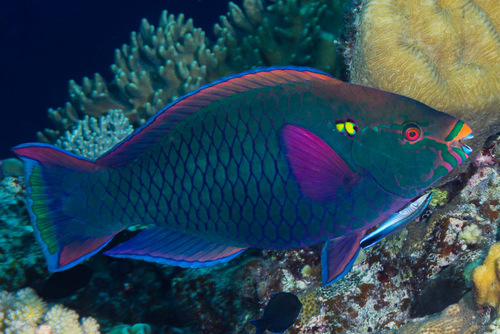
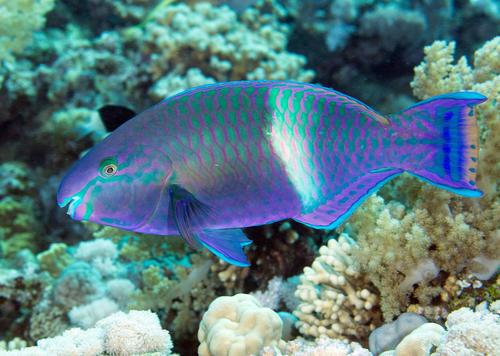
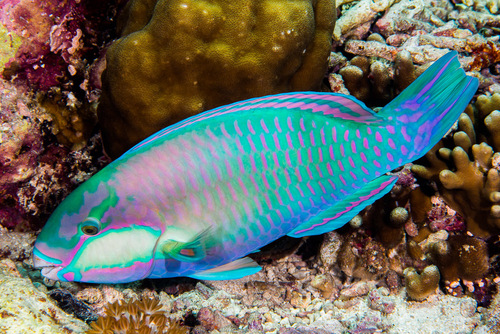
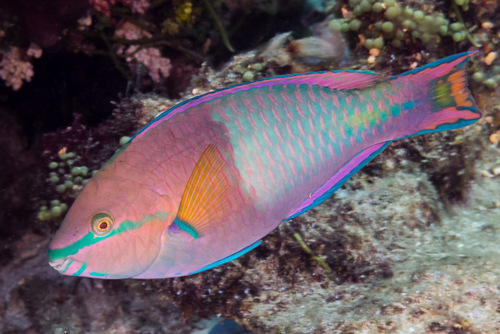
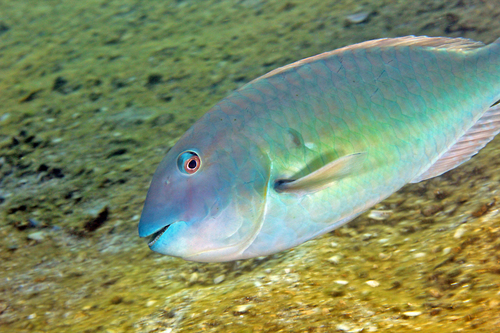
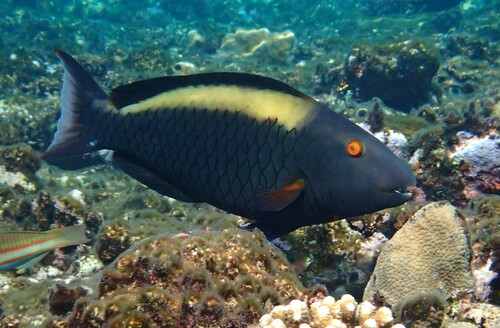
Cetoscarus bicolor (Rüppell, 1829) is one of the largest parrotfish species, reaching a maximum standard length of 80 cm (31 in). Like many of its relatives, it is a sequential hermaphrodite. All individuals start life as female, in what is called the initial phase, and later transition to male, the terminal phase of the life cycle; every individual undergoes this female-to-male sex change, and the species can also have two sex changes over its lifetime, with very large females transitioning to become bright-colored males. The development of sexual dimorphism marks the onset of sexual maturity, and molecular data and external morphology studies confirm this process, alongside sexual differences in size and coloration, is characteristic of the species. Coloration differs strongly by life cycle phase, which defines the species' overall appearance. Initial phase females are dark brown with a large cream patch on the upper body. Terminal phase males are very colorful: they are overall bright green, with pink spots across the body and bright pink edging along the fins, making mature males easily identifiable by this bright coloring. Juveniles have a very different appearance: they are white with a black spot on the dorsal fin and an orange band running through the eye. As juveniles mature, they lose the black dorsal fin spot, and their color shifts to a bright blue body with a spotted face and pink or yellow highlights around the scales. Juvenile C. bicolor are sometimes called "black tooth" due to their dark pigment bands and patches that set them apart from mature adults. Dark brown juvenile and subadult individuals develop a large white patch on the dorsal region above the dorsal fin as they grow. C. bicolor belongs to the same genus as Cetoscarus ocellatus, and C. ocellatus was historically grouped together with C. bicolor as a single species (the only species in the genus Cetoscarus). C. ocellatus is also sometimes called the bicolour parrotfish, also known as the spotted parrotfish. However, DNA data and morphological differences clearly distinguish the two species, and C. ocellatus has less vivid coloration than C. bicolor, highlighting C. bicolor's uniqueness among members of its genus. C. bicolor is associated with coral reefs. It is most commonly found in lagoons and on seaward reefs at depths between 1 and 30 m, though individual fish have been recorded as deep as 40 meters within its geographic range. This species' space use changes across different life cycle stages. Small juveniles live in dense coral and algae-rich habitats, including thick coral sections, vegetated areas, coral gardens and lagoons. These locations provide juveniles access to food and protection from predators, matching their juvenile coloration pattern. Adult C. bicolor prefer open reef areas and the outer portions of coral reefs, which they mark as feeding territories. These territories consist of coral and rocky substrate, where the fish remove algae and biofilm from reef surfaces via body scraping as part of their diet. Large coral systems within the species' range provide all the required conditions for feeding, shelter, and reproduction, with abundant algae for food and coral structure for resting and reproduction. While robust population data for this species is limited, research by Pauly and Froese notes healthy population numbers across the Red Sea region, though population densities fluctuate. The authors call for further research to establish more precise current population estimates, and to better understand the species' ability to tolerate different environmental stressors. It is expected that climate change and ongoing human activity will degrade the coral reefs that C. bicolor depends on over time. Continued conservation programs focused on protecting coral reefs are necessary to maintain stable populations of this species and preserve the overall ecological balance of fragile Red Sea habitats.