About Cethosia cydippe Linnaeus, 1767
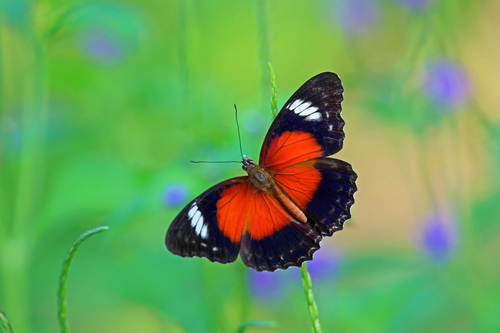
Adult Cethosia cydippe (imagines) have scarlet wings with thick black edges and a diagonal white patch on the forewings. The underside of the wings is orange, with similar white patches and rows of black spots, each outlined in white. The typical wingspan of this species is around 8 centimetres (3.1 in).
Cethosia cydippe was first described by Carl Linnaeus in 1767 in the 12th edition of Systema Naturae, where it was originally named Papilio cydippe. Linnaeus had previously used the name Papilio cydippe for a European species that is now classified in the genus Argynnis, in his work Fauna Svecica. Centuria Insectorum. While the Principle of Priority in zoological nomenclature typically requires the oldest available name to be used, the 1767 name Cethosia cydippe has been conserved against these earlier homonyms. Linnaeus originally listed the type locality as India, but this is now interpreted to refer to Indonesia, and the current accepted type locality is Ambon.
Multiple subspecies of Cethosia cydippe are recognised, including the nominate subspecies C. c. cydippe (Linnaeus, 1767) and C. c. chrysippe (Fabricius, 1775). C. c. cydippe is found in Indonesia's Aru Islands, Kai Islands, and Maluku, as well as across New Guinea, in both Indonesian Irian Jaya and Papua New Guinea. C. c. chrysippe was first described by Johan Christian Fabricius in 1775 in his Systema Entomologiae, originally as Papilio chrysippe, with a type locality of Cooktown, Queensland. This subspecies is endemic to Queensland, Australia, where it occurs in the northern Gulf Country and the north-east coastal region. All currently recognised subspecies, listed alphabetically, are: C. c. alkmene Fruhstorfer, 1902 (D'Etrecasteaux Archipelago); C. c. antoni Kawai, 1996 (Tanimbar Island); C. c. bernsteini C. & R. Felder, [1867] (Bachan, Halmahera, Morotai); C. c. cenchrites Fruhstorfer, 1909 (New Guinea); C. c. chrysippe (Fabricius, 1775) (Cape York); C. c. cleanthis Fruhstorfer, 1902 (Trobriand Islands); C. c. cydalima C. & R. Felder, [1867] (Aru, Goram); C. c. cydippe (Linnaeus, 1767) (Serang, Ambon, Saparua); C. c. cyrene Wallace, 1869 (Waigeu); C. c. damasippe C. & R. Felder, [1867] (New Guinea); C. c. doxata Fruhstorfer, 1913 (Goodenough Island); C. c. insulata Butler, 1873 (Kai Island); C. c. imperialis Butler, 1876 (Cape York to Townsville); C. c. iphigenia Fruhstorfer, 1901 (Buru); C. c. lucina Fruhstorfer, 1905 (Jobi); C. c. mysolensis Fruhstorfer, 1913 (Mysol Island); C. c. obiana Fruhstorfer, 1903 (Obi); C. c. sangira Fruhstorfer, 1906 (Sangihe?, Sangira Island); C. c. salwattensis Fruhstorfer, 1913 (Salwtti); C. c. schoutensis Joicey & Noakes, 1915 (Biak); C. c. woodlarkiana Fruhstorfer, 1902 (Woodlark Island).
In terms of ecology and life cycle, pale yellow eggs of Cethosia cydippe are laid in groups of 50 on their host plants. Hatched caterpillars are herbivorous, feeding on vines in the plant family Passifloraceae, including Adenia heterophylla (lacewing vine) and Passiflora aurantioides (Queensland passion-fruit). The caterpillars are black with yellow bands and long black hairs, and gather in groups on their host plants. The pupae are brown and spiky with black and gold markings, hang from a cremaster, and resemble a dead leaf.