About Cestrum parqui (Lam.) L'Hér.
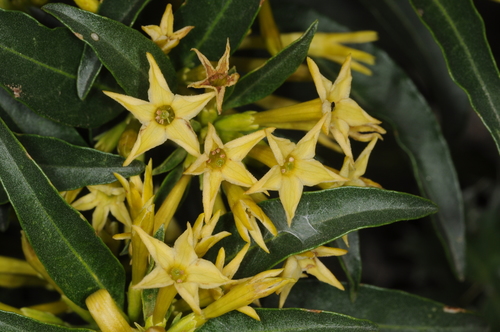
Cestrum parqui (Lam.) L'Hér. is a fast-growing, straggling, woody, semi-evergreen shrub. It reaches over 3 metres in height, growing even taller in warmer regions, and produces one or a few fragile green stems. Its leaves are alternate, light green, lance-shaped or slightly elliptical (widest at the middle), and narrowly tapered at both ends. Most leaves measure 30–65 mm long and 8–23 mm wide, and give off an unpleasant rubber-like smell when crushed. In regions with cool winters, the plant is partly deciduous. This plant contains toxic alkaloids. It has been used in folk medicine to treat tumours and haemorrhoids, and has documented sudorific (perspiration-inducing), laxative and antispasmodic properties. Decoctions or infusions of the plant have also been given for intermittent fever, and an infusion of the inner bark is drunk to treat unspecified "stomach ailments". In folk medicine, a poultice made from this plant (specific plant part unspecified), combined with unspecified parts of Solanum nigrum and crushed stems of Vitis vinifera (grape vine), is believed to have anti-inflammatory properties. A crude methanol-water extract of the plant's aerial parts showed inhibition of carrageenin-induced oedema.