About Cestrum elegans (Brongn. ex Neumann) Schltdl.
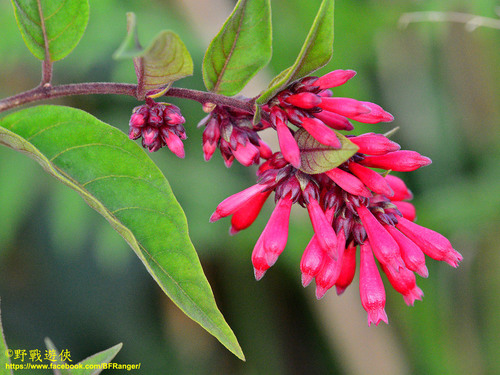
Cestrum elegans (Brongn. ex Neumann) Schltdl. is a slender, compact evergreen shrub that reaches up to seven feet in height, with only a few branches. Its closely compacted panicles form at the top of the plant. Downy, pendulous, hairy shoots bear simple, alternate leaves that are oblong to ovate with pointed tips, entire margins, and a mid-green color. Leaves reach eight centimeters in length, arranged alternately on stems, and have a distasteful smell, while the plant's flowers have a sweet scent. Leaves are associated with funnel-shaped bright purplish-red, nearly blood red flowers that have 5 pointed lobes; flowers are typically 2 centimeters long. Immature stems are densely covered in purplish hairs, and become woody as the plant matures. When grown in warm temperate climates, the plant's leaves are soft and hairy. Flowering occurs from August to March. The plant can produce crimson to dark red berries. It grows best in semi-shaded conditions, in fertile, non-compacted soil, and tolerates periods of drought. Hummingbirds pollinate Cestrum elegans. All parts of the plant are poisonous if ingested. This species requires a warm temperate to tropical, consistently frost-free climate. It is native to the American tropics, with a range spanning from Florida to central Chile, and can also be found in some parts of Britain. Within the United States, it occurs in central to southern California, northeast Texas, and central to southern Florida. The lowest temperature it can tolerate is −7 °C, which corresponds to USDA hardiness zone 9. Cestrum elegans is most commonly grown as an ornamental plant. It is frequently cultivated in greenhouses, where it grows up pillars or rafters, and is also grown as a wall shrub in sheltered gardens. It is often grown in conservatories, cool glasshouses, or hanging baskets. When trained to grow up a large structure such as a pillar, it grows best when planted in large containers. It attracts many pollinators and hummingbirds.