About Cestrum diurnum L.
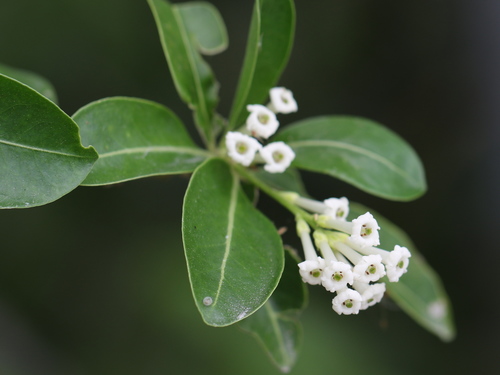
Cestrum diurnum L. is an erect evergreen woody shrub with many leafy branches. Young branches are green, marked with prominent white lenticels, and turn fawn-colored as they age. Younger plant parts are covered in very sparse glandular scruf. Its leaves are simple, glabrous, entire, alternate, and ex-stipulate, with an ovate-lanceolate shape, an obtuse apex, and an obtusely wedge-shaped base. The upper leaf surface is dark green, while the lower surface is pale; leaves typically grow to 5 inches long and 1.5 inches wide, and are borne on 0.5-inch long petioles. Its inflorescence forms on a long axillary peduncle that holds short clusters of white, sweet-smelling flowers. Each cluster is subtended by a leaf-like bract. Individual flowers are sessile, and may have or lack bracteoles. The calyx is gamosepalous, around 0.15 inches long, somewhat puberulent, obtusely 5-ribbed, and divided into 5 obtuse, ciliate lobes. The corolla tube is narrowly funnel-shaped (infundibuliform), white, and sweet-scented, and is around half an inch long, divided into 5 lobes. The lobes are very obtuse and curve completely backward when the flower is fully open. It has 5 oblong, brown stamens that alternate with the corolla lobes and are included within the corolla tube. Filaments are adnate to the corolla tube, and are only free for a very short section. The ovary sits on a nectar-secreting disk, the style is filiform and glabrous, and the stigmas are truncate-capitate. After flowering, Cestrum diurnum produces a black, nearly globular berry. It is native to the West Indies, and is widely cultivated in gardens across India. Cestrum diurnum is one of only three rangeland plants confirmed to contain glycosides of 1,25-dihydroxycholecalciferol (1,25-OHD3), a metabolite of vitamin D. When grazing animals consume these 1,25-OHD3 glycosides, they develop vitamin D toxicity that causes calcinosis, the excessive deposition of calcium in soft tissues. The leaves of Cestrum diurnum are reported to be a source of vitamin D3. Its aerial parts are also reported to have cytotoxic and thrombolytic activities.