About Ceryle rudis (Linnaeus, 1758)
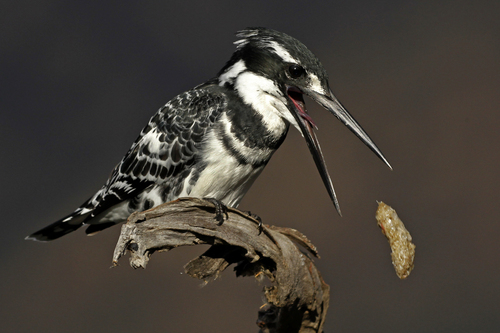
This is a medium-sized kingfisher, with a total length of approximately 25 cm (9.8 in). Its plumage is primarily white, marked by a black facial mask, a white supercilium, and black breast bands. It has a neat crest, and its upperparts feature black barring. Multiple subspecies are recognized across its wide geographic range. The nominate subspecies occurs in sub-Saharan Africa, with its range extending into West Asia. The subspecies syriacus is a larger bird found in northern areas, matching the pattern described by Bergmann's rule and being similar to the nominate subspecies. Subspecies leucomelanura ranges from Afghanistan eastward through India, Thailand, and into Southeast Asia. The subspecies travancoreensis, native to the Western Ghats, is darker overall and has less white plumage. Subspecies C. r. insignis occurs in Hainan and southeastern China, and has a much larger bill. Males of the species have a narrow second breast band, while females have a single broken breast band. This species is common across sub-Saharan Africa and southern Asia, ranging from Turkey through India to China. It is a resident species; most individuals do not migrate, only making short-distance seasonal movements. In India, it is found mainly on the plains, and is replaced in the higher hills of the Himalayas by the crested kingfisher (Megaceryle lugubris). The pied kingfisher is estimated to be one of the three most abundant kingfisher species in the world; the other two are the common kingfisher (Alcedo atthis) and the collared kingfisher (Todiramphus chloris). It is a noisy bird, so it is difficult to overlook.