About Cervus nippon Temminck, 1838
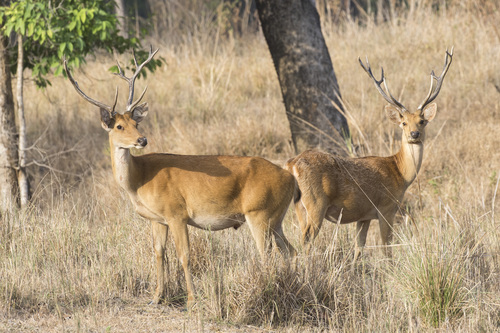
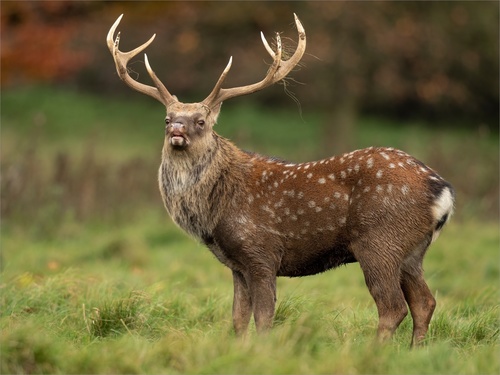
The sika deer (Cervus nippon Temminck, 1838) is one of the few deer species that retain their spots when they reach adulthood. Spot patterns differ by geographic region: mainland subspecies have larger, more obvious spots, while Taiwanese and Japanese subspecies have spots that are nearly invisible. Many introduced sika deer populations originate from Japan, so these populations also do not have prominent spots. The color of the sika deer's fur (pelage) ranges from mahogany to black, and all-white individuals have been recorded. In winter, the coat becomes darker and shaggier, spots become less prominent, and a mane grows on the back of the neck of male deer. Sika deer are medium-sized herbivores, with notable size variation across their subspecies and strong sexual dimorphism: males are always much larger than females. Shoulder height ranges from 50 to 110 cm (20 to 45 in), head-and-body length ranges from 95 to 180 cm (35 to 70 in), and tail length is between 7.5 and 13 cm (3 to 5 in). The largest subspecies is the Manchurian sika deer (C. n. mantchuricus), where males typically weigh 68–109 kg (150–240 lb) and females weigh 45–50 kg (100–110 lb); large male Manchurian sika deer can reach 160 kg (350 lb), and male Yezo sika deer have been recorded weighing up to 170 or 200 kg (370 or 440 lb). At the smaller end of the size range, Japanese sika deer (C. n. nippon) males weigh 40–70 kg (90–150 lb) and females weigh 30–40 kg (70–90 lb). All sika deer have compact bodies, slender legs, short, neat wedge-shaped heads, and an active, energetic temperament. When alarmed, they often display a distinctive flared rump patch, similar to the American elk. Male sika deer (stags) have stout, upright antlers with an extra buttress extending upward from the brow tine and a very thick wall. A forward-facing intermediate tine interrupts the line to the top of the antler, which is usually forked. Occasionally, sika deer antlers develop some palmation (flat expanded areas). Female sika deer have a pair of distinctive black bumps on the forehead. Antler length ranges from 28 to 45 cm (11 to 17+1⁄2 in) to over 80 cm (30 in), depending on the subspecies. Stags also grow distinctive manes during their mating season (rut). Sika deer have well-developed metatarsal and preorbital glands. The volatile chemical components of these glands have been examined from a free-ranging female sika deer. The metatarsal gland contained 35 compounds, including long-chain carboxylic acids, straight-chain aldehydes, long-chain alcohols, one ketone, and cholesterol. The preorbital gland contained C14 through C18 straight-chain and branched-chain fatty acids. In their native range, sika deer live in temperate and subtropical forests of eastern Asia. They prefer areas with dense understory, occasional clearings, and snowfall that does not exceed 10–20 cm (4–8 in), though they are known to occupy areas with a maximum snow depth of up to 50 cm (19.6 in) in their native range. They typically forage in patchy forest clearings. Introduced sika deer populations live in habitats similar to their native range, and are found in Western and Central Europe, the eastern United States, and New Zealand.