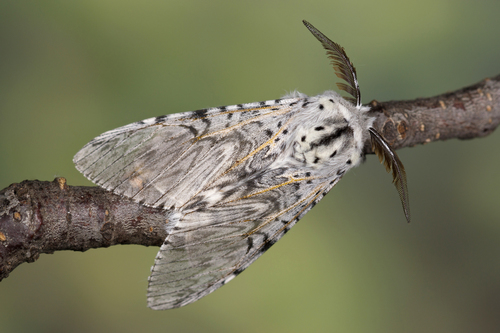
About Cerura vinula Linnaeus, 1758
Cerura vinula (Linnaeus, 1758), commonly called the puss moth, has a wingspan ranging from 58 millimetres (2.3 in) to 75 millimetres (3.0 in), with males being slightly smaller than females. The head, thorax, and entire body of these moths are extremely fluffy, giving them a cat-like appearance that inspired their common English name. Their antennae are bipectinated. Their forewings are white or yellowish-gray, crossed by multiple wave-like dark lines. Male hindwings are light gray or whitish, while female hindwings are suffused with blackish coloration and almost transparent. The body is whitish gray, and the dorsal side of the abdomen is marked with black bands. Fully grown caterpillars reach a length of about 80 millimetres (3.1 in). Newly hatched caterpillars are completely black; after moulting, they become light green with a dark dorsal pattern outlined in white or yellow. Mature caterpillars also develop a forked tail structure with two long dark tips that hold red, extendable flagellae. The chrysalis is reddish brown, and is enclosed in a hard cocoon that attaches to the caterpillar's host plant. This moth species is native to the Palearctic realm. It occurs across all of Europe, including Albania, Austria, Belarus, Belgium, Bosnia and Herzegovina, the United Kingdom, Bulgaria, European Russia, Croatia, Czech Republic, Denmark, Estonia, European Turkey, Finland, France, Germany, Greece, Hungary, Ireland, Italy, Latvia, Lithuania, Republic of North Macedonia, Republic of Moldova, Norway, Poland, Romania, Slovakia, Slovenia, Spain, Sweden, Switzerland, the Netherlands, Ukraine and Yugoslavia. Its range extends across temperate Asia to China, and it is also found in North Africa. This moth primarily inhabits very dense woodland areas.