About Certhionyx variegatus R.Lesson, 1830
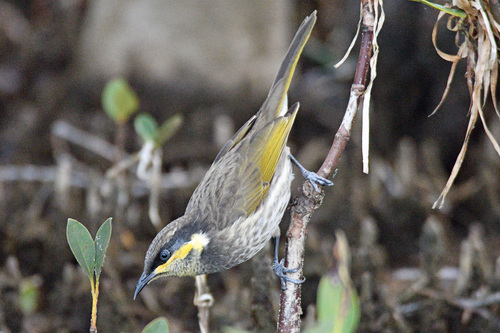
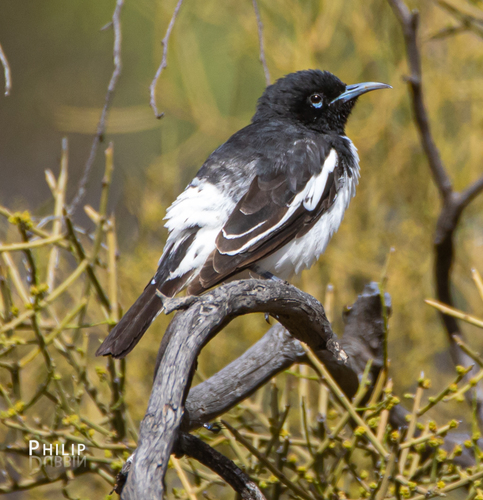
Certhionyx variegatus R.Lesson, 1830, commonly known as the pied honeyeater, has a long curved bill and a small semicircular patch of pale-blue bare skin below the eye; in females and juveniles this patch is arc-shaped rather than semicircular. Males have a black and white plumage pattern: a black head, neck, and upper body, a white lower rump and upper tail, black wings marked with a white stripe, white underparts, and a black-tipped tail. Females have brown upperparts, a grey-white chin, a whitish breast streaked and spotted with dark brown, white underparts, and a white stripe along the edges of their secondary wing feathers. This is a mid-sized honeyeater, with adults reaching an approximate weight of 27 g (0.95 oz), a body length between 15 and 20 cm (5.9 and 7.9 in), and a wingspan between 25 and 29 cm (9.8 and 11.4 in). The species is characterized by long pointed wings, a trait that reflects its broad continent-wide movement patterns. The pied honeyeater’s call is described as a mournful whistle that resembles the call of the little grassbird (Megalurus gramineus). During the breeding season, it produces a melancholy piping note. The black honeyeater (Sugomel nigrum) is superficially similar in appearance to the pied honeyeater, but differs in several key traits: it has a different call, is smaller in size, has a finer bill and shorter tail, and lacks the bare skin patch below the eye. Male black honeyeaters also have a distinctive stripe running down the center of the chest and abdomen, while female black honeyeaters have plainer wing patterns and less breast streaking than female pied honeyeaters. In the early 1900s, the pied honeyeater was recorded as widely distributed, mainly across the southern half of the Australian continent. 1962 data mapping by Gannon shows the species occurs primarily across central and western New South Wales, the arid Australian interior, and eastern parts of South Australia. Data from the Birdlife Australia Atlas project collected between 1998 and 2014 indicates the pied honeyeater is found mainly in a band below approximately 18 ° S, stretching from central Queensland, central New South Wales, and central Victoria in the east across to the Western Australian coastline. The pied honeyeater occupies arid and semi-arid zones, including the sandhills of inland plains, inland ranges, granite outcrops, and the coastal sandhills of Western Australia. It is commonly found in shrublands dominated by emu bush (Eremophila spp.) and grevilleas, and woodlands predominantly made up of mulga. Its habitat may also include scattered river red gum (Eucalyptus camaldulensis) growing along watercourses, as well as Casuarina and Myoporum growing along dry watercourses and dry salt-lakes. The species also lives in spinifex-dominated grasslands that contain scattered stands of mulga (Acacia aneura), Casuarina, and bloodwood (Corymbia terminalis). The usual breeding season for the pied honeyeater runs from June through the following five months, with nests containing eggs found most often in August and September. There are recorded cases of breeding occurring in March in central and northern Australia, typically after heavy rain events. Both sexes participate in nest construction, egg incubation, and caring for young. According to 1946 records from Burgess, nests can be built and eggs laid within 3 days. Nests are built between 1.2 and 1.5 m (3.9 and 4.9 ft) above ground, in low shrubs or trees including mulga, cork bark (Hakea lorea), and sandalwood (Santalum), or on top of thick creepers. Nests are typically open, deep, saucer-shaped, well-built structures made from twigs or short grass stems such as spinifex, bound together with spider web. They may be placed on thin twigs at the end of a branch or at the junction of several thin horizontal leafy stems, and suspended by their rim. Eggs measure approximately 1.6 cm (0.6 in) wide by 2.4 cm (0.9 in) long, and range in shape from oval to rounded to elongate oval. The egg shell is close-grained, smooth, and usually lustreless, with a dull white base colour evenly covered with blackish-brown freckles and spots, overlaid on underlying dull bluish-grey markings.