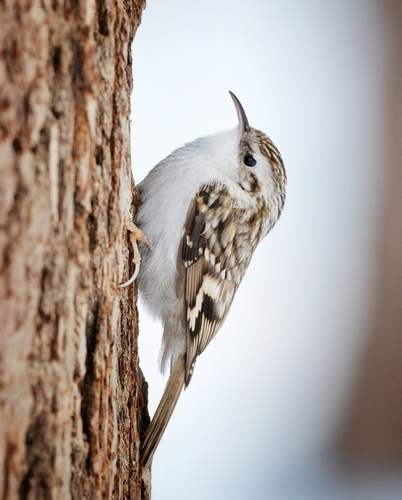
About Certhia familiaris Linnaeus, 1758
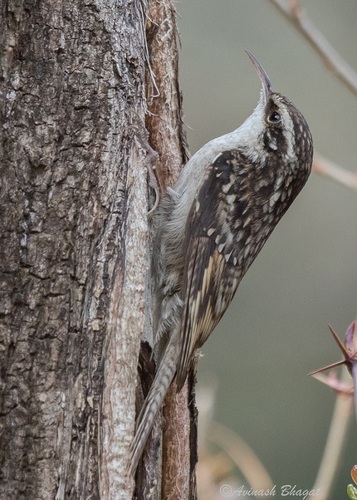
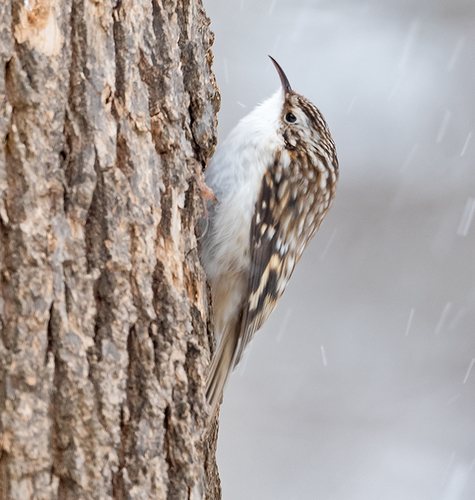
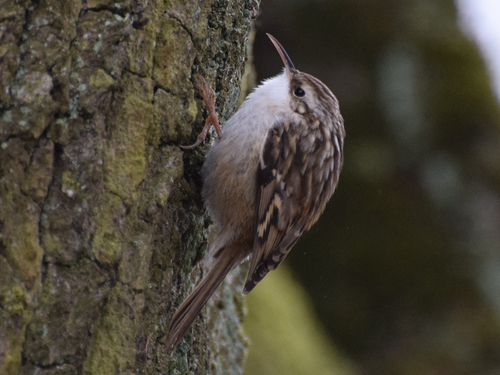
All treecreepers share similar physical characteristics: they are small birds with streaked and spotted brown upperparts, rufous rumps, and whitish underparts. They have long curved downward bills, and long rigid tail feathers that support them as they creep up tree trunks searching for insects. This species, the Eurasian treecreeper (Certhia familiaris Linnaeus, 1758), is 12.5 cm (4.9 in) long and weighs 7.0–12.9 g (0.25–0.46 oz). It has warm brown upperparts with intricate patterning in black, buff, and white, along with a plain brown tail. Its belly, flanks, and vent area are tinted with buff. The sexes look similar to one another. Juveniles have duller upperparts than adults, and their dull white underparts have fine dark spotting on the flanks.
Its contact call is a very quiet, thin, high-pitched "sit", while its most distinctive call is a penetrating "tsree" with a vibrato quality, sometimes repeated as a series of notes. The male's song starts with "srrih, srrih", followed by a few twittering notes, a longer descending ripple, and a whistle that falls then rises.
The Eurasian treecreeper's range overlaps with several other treecreeper species, which can create local identification challenges. In Europe, it shares most of its range with the short-toed treecreeper. Compared to the short-toed treecreeper, the Eurasian treecreeper is whiter on its underparts, warmer and more spotted on its upperparts, has a whiter supercilium, and a slightly shorter bill. Even when examined in the hand, visual identification may be impossible for birds with faint markings. Singing individuals are usually identifiable, because the short-toed treecreeper has a distinctive song of evenly spaced notes that sounds quite different from the Eurasian treecreeper's song. However, both species have been recorded singing the other species' song.
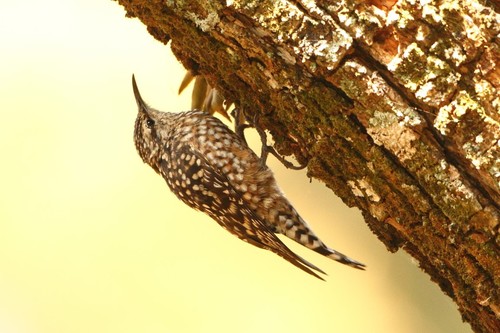
Three Himalayan subspecies of Eurasian treecreeper are sometimes classified as a separate full species called Hodgson's treecreeper, for example by BirdLife International. If these are retained as subspecies of the Eurasian treecreeper, they must be distinguished from three other South Asian treecreeper species. The Eurasian treecreeper's plain tail sets it apart from the bar-tailed treecreeper, which has a distinct barred tail pattern, and its white throat is an obvious difference from the brown-throated treecreeper. Separating the rusty-flanked treecreeper from the Eurasian treecreeper is more difficult, but the rusty-flanked treecreeper has more contrasting cinnamon rather than buff flanks.
The North American brown creeper has never been recorded in Europe, but an autumn vagrant would be hard to identify, since it would not be singing, and the brown creeper's call is very similar to the Eurasian treecreeper's call. In appearance, the brown creeper resembles the short-toed treecreeper more than the Eurasian treecreeper, but similarities between all three species mean a vagrant brown creeper might still not be identifiable with certainty.
The Eurasian treecreeper is the most widely distributed member of its genus. It breeds in temperate woodlands across the Palearctic, ranging from Ireland to Japan. It prefers mature trees. Across most of Europe, where it shares its range with the short-toed treecreeper, it is found mainly in coniferous forest, especially spruce and fir. Where it is the only treecreeper species present, such as in European Russia or the British Isles, it favors broadleaved or mixed woodland over coniferous woodland. It also occurs in parks and large gardens.
In the northern part of its range, the Eurasian treecreeper breeds down to sea level, but further south it is typically a highland species. In the Pyrenees it breeds above 1,370 metres (4,490 feet), in China it breeds at 400–2,100 metres (1,300–6,900 ft), and in southern Japan it breeds at 1,065–2,135 metres (3,494–7,005 ft). Its breeding areas have July isotherms between 14–16 °C (57–61 °F) and 23–24 °C (73–75 °F).
It is non-migratory in the milder west and south of its breeding range, but some northern birds move south in winter, and individuals that breed in mountains may descend to lower altitudes in winter. Winter movements and post-breeding dispersal can lead to vagrancy outside the species' normal range. Wintering migrants of Asian subspecies have been recorded in South Korea and China, and the nominate subspecies has been recorded west of its breeding range as far as Orkney, Scotland. The Eurasian treecreeper has also occurred as a vagrant to the Channel Islands (where short-toed treecreeper is the resident species), Mallorca, and the Faroe Islands.