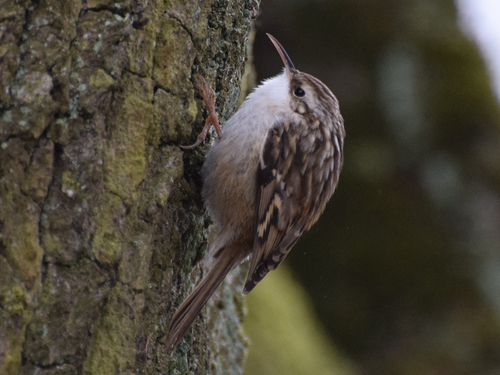
About Certhia brachydactyla C.L.Brehm, 1820
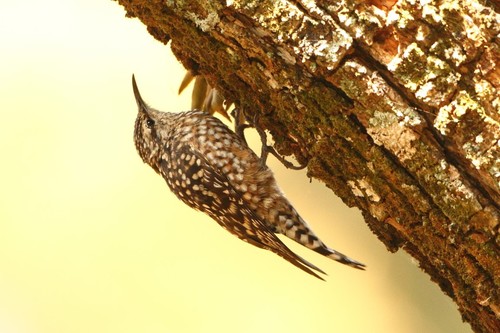
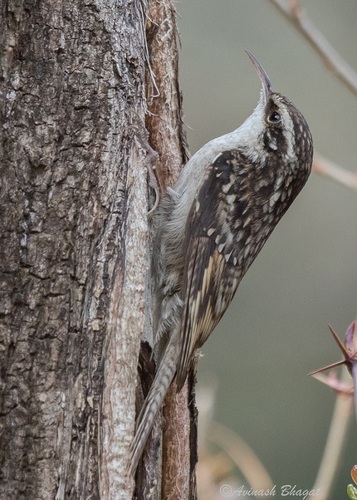
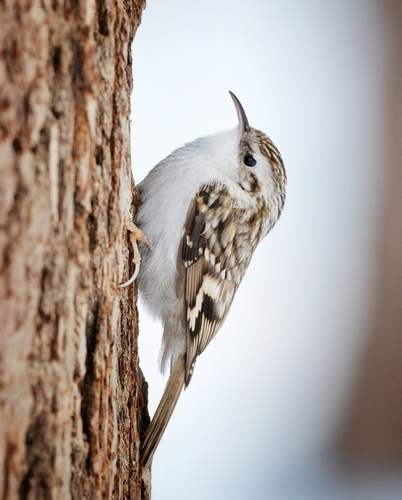
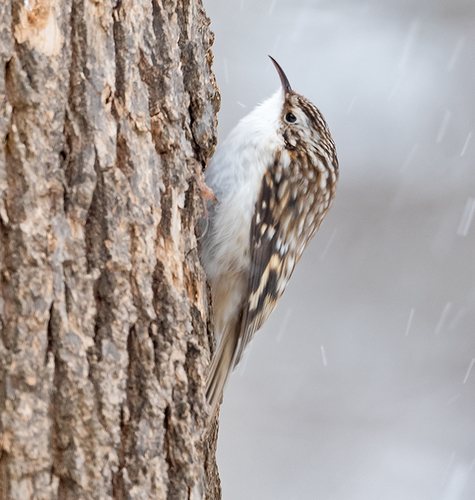
All treecreepers share a similar general appearance: they are small birds with streaked and spotted brown upperparts, rufous rumps, whitish underparts, long decurved bills, and long stiff tail feathers that provide support as they creep up tree trunks searching for insects. The short-toed treecreeper, Certhia brachydactyla, measures 12.5 centimetres (4.9 inches) long and weighs 7.5–11 g (0.26–0.39 oz). It has dull grey-brown upperparts intricately patterned with black, buff and white, a weak off-white supercilium, and dingy underparts that contrast with its white throat. Males and females look identical, while juveniles have whitish underparts, sometimes with a buff belly. The call of this species is a repeated shrill tyt...tyt tyt-tyt. The song of the nominate subspecies is an evenly spaced sequence of notes: teet-teet-teet-e-roi-tiit. There is geographical variation in the species' song: the song of Danish birds is shorter, the song of the Cyprus subspecies is very short and simple, and the North African variant is lower pitched. European short-toed treecreepers do not respond to these last two song variants. This species shares much of its range with the common treecreeper. Compared to the short-toed treecreeper, the common treecreeper is whiter below, warmer and more spotted above, has a whiter supercilium, and a slightly shorter bill. However, visual identification may be impossible for birds with unclear species markings. Vocal individuals can usually be identified, since the common treecreeper has a distinctive song made up of twitters, ripples and a final whistle, plus a shree call that the short-toed treecreeper rarely gives; despite this, both species have been recorded singing the other species' song. Even when examined in the hand, although the short-toed treecreeper usually has a longer bill and shorter toes, 5% of individuals cannot be safely identified. The brown treecreeper has never been recorded in Europe, but it would be difficult to distinguish from the short-toed treecreeper, which it closely resembles in appearance. The brown treecreeper's call is more similar to the common treecreeper's, but a vagrant brown treecreeper might still not be identifiable with certainty due to the similarities between all three species. The short-toed treecreeper breeds in temperate woodlands across Europe, ranging from Portugal to Turkey and Greece, and also breeds in north west Africa. It prefers well-grown trees, especially oak, and avoids pure conifer stands. Where it shares its European range with the common treecreeper, the common treecreeper tends to occur mainly in coniferous forest and at higher altitudes. The short-toed treecreeper is usually found in lowlands, but breeds locally at up to 900 metres (3,000 feet) in Germany, 1,800 metres (5,900 feet) in France and 1,400 metres (4,600 feet) in Switzerland. In Turkey and North Africa, it is a mountain species. Its breeding areas occur where July isotherms range between 17–18 °C (63–64 °F) and 26 °C (79 °F). This treecreeper is essentially non-migratory, but post-breeding dispersal can lead to vagrancy outside its normal range. It has been recorded as a vagrant in England, Sweden, Lithuania and the Balearic Islands. Three individuals recorded on Corsica in 1969 appear to belong to the North African subspecies C. b. mauritanica.