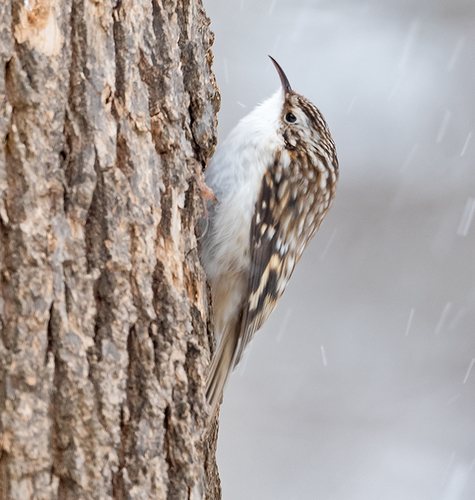
About Certhia americana Bonaparte, 1838
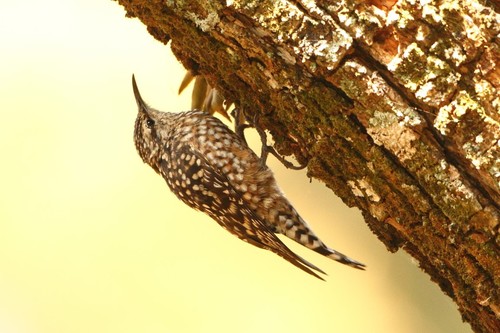
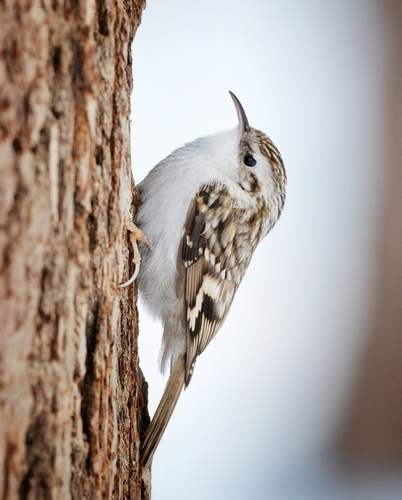
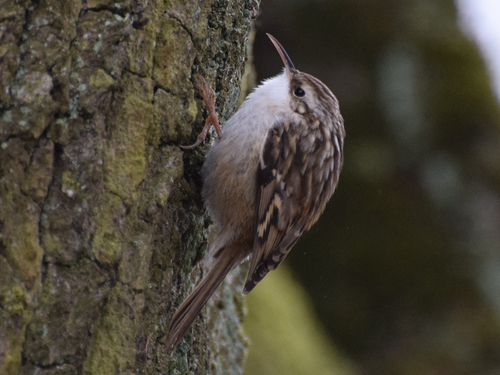
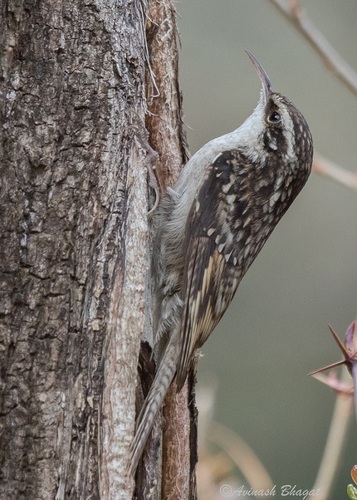
This species, the brown creeper, has the scientific name Certhia americana Bonaparte, 1838. Adult brown creepers have spotted brown upperparts that look like tree bark, and plain white underparts. They have a long, thin bill that curves slightly downward, plus a long, stiff tail that supports the bird as it creeps upward along tree trunks. Males have slightly larger bills than females. Brown creepers are smaller than white-breasted nuthatches, but larger than golden-crowned kinglets. Their body measurements range as follows: length 4.7–5.5 in (12–14 cm), weight 0.2–0.3 oz (5.7–8.5 g), and wingspan 6.7–7.9 in (17–20 cm). Brown creepers make very high-pitched, short, piercing, often insistent single calls that sound like see or swee. Their songs follow a cadence described as pee pee willow wee or see tidle swee, with notes that match the tone of their calls. For California populations, songs typically hold 4 to 9 syllables. The only exception is populations in the San Bernardino Mountains, where songs have 9 to 13 syllables, but still fit within the same two-second time frame. Compared to many other bird species, brown creepers have a low detection rate during surveys; this is caused by their tendency to avoid habitat edges, their camouflaged plumage, and their high-pitched vocalizations that are hard to hear. Brown creepers live across North America, where some populations are year-round residents and others are migratory. Their breeding habitat is mature forest, especially coniferous forest, across Canada, Alaska, and the northeastern and western United States. They live in the southern United States only during the non-breeding season. Most of the species' range holds permanent resident populations, while many birds from northern populations migrate to the southern half of the United States for non-breeding season. Brown creepers have also been recorded as vagrants in Bermuda and the mountain regions of Central America, including Guatemala, Honduras, and the northern cordillera of El Salvador. Since 1966, brown creeper populations have increased by 1.5% per year across the northeastern and northwestern Pacific coast regions of their range. The first record of breeding brown creepers in the Northwest Territories came from the Liard Valley in 2008, which may indicate an ongoing northern range expansion. As a migratory species with a northern range, the brown creeper could potentially appear as a vagrant in western Europe. The species sits intermediate in physical characteristics between the European common treecreeper and short-toed treecreeper. In the past, it was sometimes classified as a subspecies of the common treecreeper, though research from 2006 indicates its closest relative is actually the short-toed treecreeper. Because the two European treecreeper species are already extremely difficult to distinguish from one another, a vagrant brown creeper would likely not be suspected unless found on a treeless western European island, and would be hard to verify even in that location. Brown creepers prefer mature, moist coniferous forests or mixed coniferous-deciduous forests. They can also live in drier forest types, including the Engelmann spruce and western larch forests of eastern Washington. They generally avoid the outer coastal rainforest habitat of the Pacific Northwest. While they most often nest in hardwood trees, they prefer conifers for foraging. Breeding brown creepers need large-diameter trees, whose deep bark furrows hold large populations of bark-dwelling invertebrates like spiders that act as their foraging food source. They also require a steady supply of new snags; in the New Brunswick breeding range, they show a specific preference for balsam fir. Brown creepers have been recorded breeding during the dry season (January to February) in Chalatenango Department, El Salvador. This is an unusual breeding timing for insectivorous birds, and only the golden-fronted woodpecker shares this unusual dry-season breeding habit in the same region.