About Cerrena unicolor (Bull.) Murrill
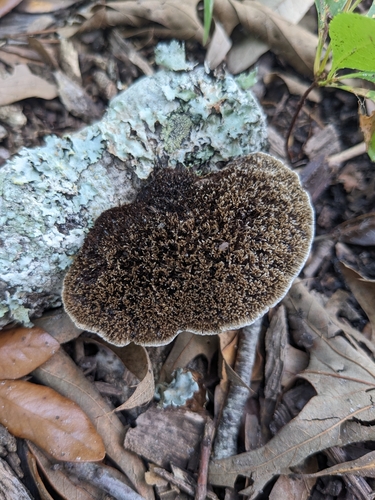
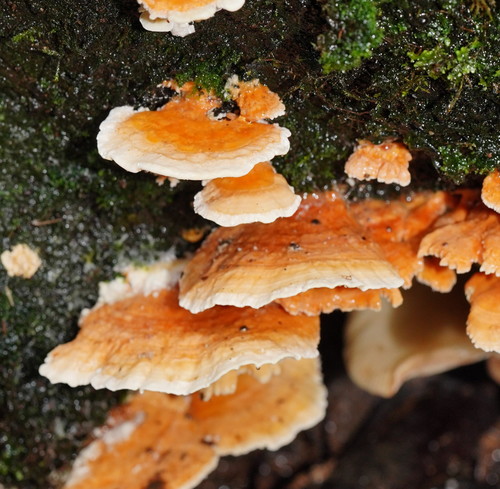
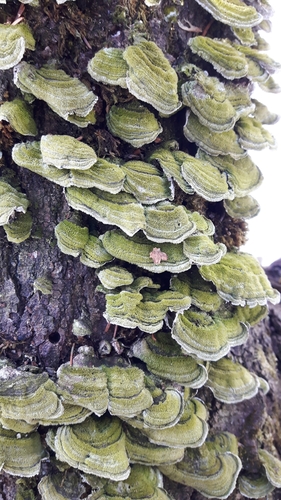
Cerrena unicolor, with the scientific name Cerrena unicolor (Bull.) Murrill, produces semicircular, wavy bracket-shaped fruit bodies that reach up to 10 centimeters (4 inches) wide, and typically grow in groups of 2 to 20. The fruit bodies attach directly to their growing surface without a stalk, which is described as sessile. The upper surface of the fruit body is finely hairy, colored white to grayish brown, and zonate, meaning it is marked with zones or concentric color bands. This upper surface often appears green due to algal growth. The pore surface is whitish on young specimens, and turns gray as the fungus matures. The pores are arranged in a maze-like pattern of slots, and the pore tubes can extend up to 4 millimeters deep. As the fungus ages, pores develop into tooth-like structures. The spore print of Cerrena unicolor is white. Its spores are elliptical, smooth, hyaline, and inamyloid, with dimensions of 5–7 by 2.5–4 micrometers. The 4-spored basidia measure 20–25 by 5–6 micrometers and have basal clamps. Cystidia measure 40–60 by 4–5 micrometers and are thin-walled. This fungus has a trimitic hyphal system, which contains generative, skeletal, and binding hyphae. Generative context hyphae are 2–4 micrometers wide, thin-walled, and nodose-septate. Skeletal context hyphae are wider, thicker-walled, and lack septa. Binding and tramal hyphae are 2–4 micrometers wide, thick-walled, lack septa, and are highly branched. This fungus has a wide distribution, and can be found in Asia, Europe, South America, and North America. Ecologically, Cerrena unicolor causes canker rot and decay in paper birch (Betula papyrifera) and sugar maple (Acer saccharum). It causes white rot on deciduous hardwoods, and rarely causes rot on conifers. It can be found year-round. When a female wasp from the genus Tremex bores into wood near this fungus, C. unicolor spores become trapped in the wasp's ovipositor. The spores are carried along with the wasp's eggs, and eventually germinate at the site where the eggs are laid. After spores germinate and form mycelium, the wasp eggs hatch, and the newly hatched larvae feed on the fungal mycelium. The wasp species Tremex columba requires Cerrena unicolor for its larvae to develop; without this interaction, the wasp larvae die. A parasitic wasp from the genus Megarhyssa lays its eggs inside Tremex wasp larvae. When Megarhyssa larvae hatch, they eat the Tremex larvae, which helps control Tremex population levels. Cerrena unicolor has been identified as a source of the enzyme laccase. This enzyme has potential applications across a wide variety of bioprocesses. C. unicolor produces laccase in culture under more favorable conditions and at higher yields than many other wood-rotting fungi, so current research focuses on developing methods to produce laccase cost-effectively at large scale. This fungus is inedible to humans.