About Cerrena hydnoides (Sw.) Zmitr.
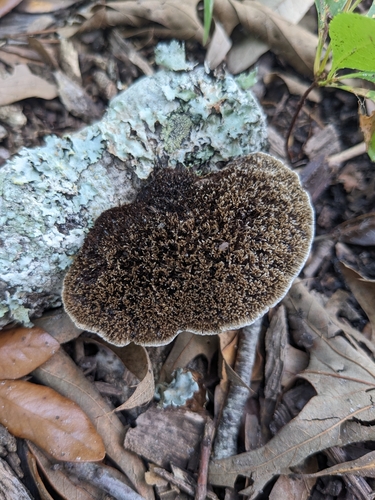
Cerrena hydnoides (Sw.) Zmitr., formerly known as Hexagonia hydnoides, forms annual semicircular fruiting bodies that attach sessile (stalkless) to dead wood, such as fallen oak. Its pileus (cap) is convex or nearly flat, measuring 1 to 12 centimetres (1⁄2 to 4+1⁄2 in) across, and can grow up to 1.8 cm thick at the base. The upper cap surface is zonate, with concentric striping patterns ranging from faint to brightly colored, and is otherwise brown or dark brown. The cap is distinctly covered in fine, dark brown to black bristles that dry and harden as the fungus ages. The hymenium is brown to dark brown, made up of many thin, angular or hexagonal pores 0.1 to 0.2 mm in diameter and 2 to 6 mm deep. The hymenium darkens when rubbed. The fungus' flesh is tough and orangish-brown. Microscopically, its spores measure 11–14 by 3.5–5 microns, are cylindrical, smooth, hyaline (colorless), and inamyloid under Melzer's reagent. It has a trimitic hyphal system containing generative, skeletal, and binding hyphae, with clamp connections present on the binding hyphae. This fungus is mostly found growing on dead hardwood in tropical and subtropical forests, especially in North America. iNaturalist geographic records include sightings in the eastern United States, Mexico, the Caribbean, Brazil, Spain, India, South Africa, across most of Central and South America, and in other Southern and East African countries. Cerrena hydnoides is saprobic, most commonly decaying fallen hardwood trees. It is a white rot fungus, meaning it secretes enzymes that break down wood components including cellulose, hemicellulose, and lignin; lignin cannot be digested by some wood-decay fungi. It is also known to be a plant pathogen that decays living wood, though this topic has not been researched in depth. Due to its tough, woody texture, Cerrena hydnoides is considered inedible. However, therapeutic compounds can be extracted from its basidiocarp for use in traditional herbal medicines such as teas after grinding into a powder. A 2021 study analyzed traditional knowledge, usage, and effects of various fungi in rural Northeastern Brazilian communities, where this species was specifically cited for use to treat infant colic, as an antispasmodic therapy for the digestive system. Further analysis found it has antibacterial properties from saponin compounds. A similar study found that extracts from this fungus are effective antibacterial agents against Bacillus cereus. Usage of this species in traditional medicine, especially among populations in South America and particularly in Brazilian rainforest regions, is endangered by increased access to commercially produced medicines, loss of traditional knowledge across generations, and declining fungal populations due to environmental factors like deforestation. It is also reported to be used as medicine in Mexico to treat pimples, warts, and ringworm.