About Ceropales bipunctata
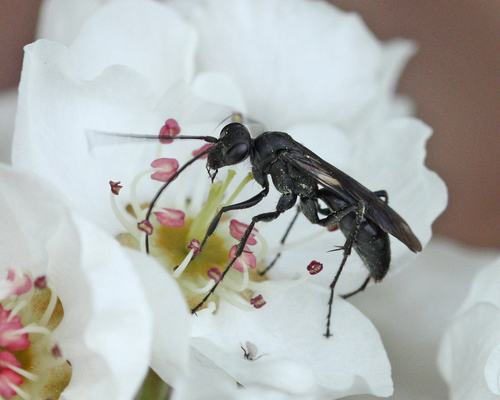
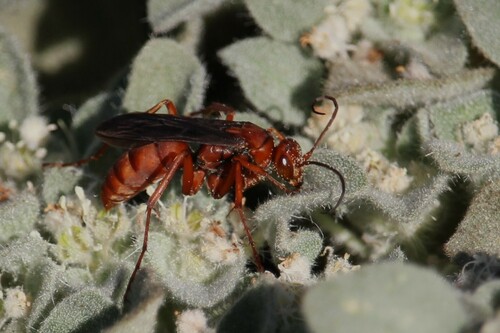
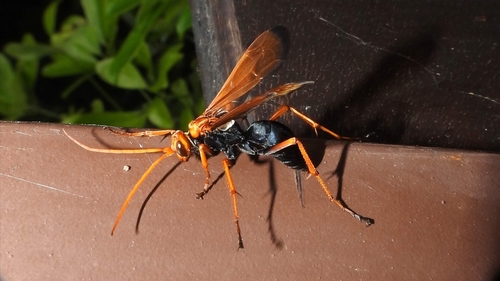
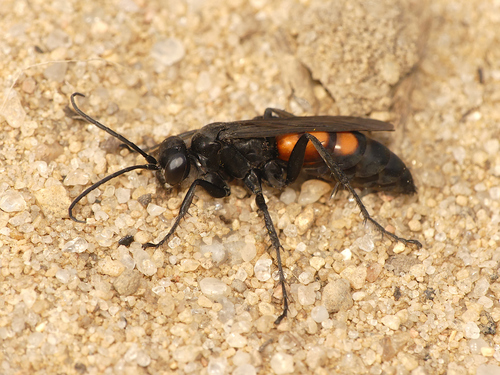
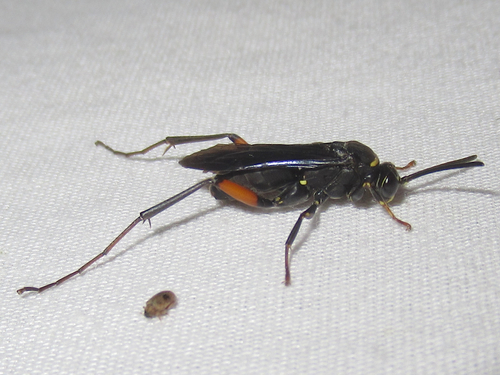
Identification of Ceropales bipunctata is most often based on the presence of one cream-colored dot on each side of the thorax. The species has two recognized subspecies. The subspecies Ceropales bipunctata tibialis is generally more black in overall color, but it still bears the species’ distinctive cream-colored spot. The main difference that distinguishes this subspecies is that its two pairs of short legs are entirely red or pink, and the entire femur of its longer leg pairs is also red. The nominate subspecies, Ceropales bipunctata bipunctata, is the subspecies shown in most published images of the full species, and the specimen photographed for this species profile is also C. b. bipunctata. For geographic distribution, the full species occurs along the Atlantic Coast of North America, ranging north to New Brunswick, Canada. This coastal population extends west as far as Ohio. There is a separate isolated population of the species in the U.S. Midwest, located in Missouri and Arkansas. It is currently unknown whether any continuous populations connect the Atlantic Coast and Midwest groups. The tibialis subspecies is only found in North Carolina and South Carolina. All other populations of the species consist solely of the nominate subspecies C. b. bipunctata. The species has declined significantly across parts of its range, most notably in Ontario. Until recently, it was also thought to be declining in New Brunswick, but new research has found the species to be common in certain dune systems in the province. Ceropales bipunctata is an under-collected species, known from only scattered specimens. It currently holds no formal protected status. For habitat, C. bipunctata lives in dune systems and open fields, and the species generally occupies open areas.