About Ceriops tagal (Perr.) C.B.Rob.
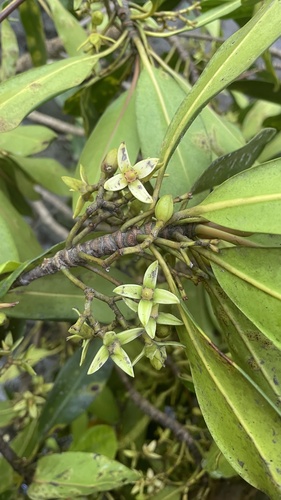
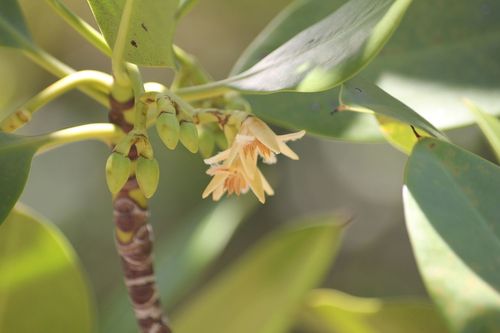
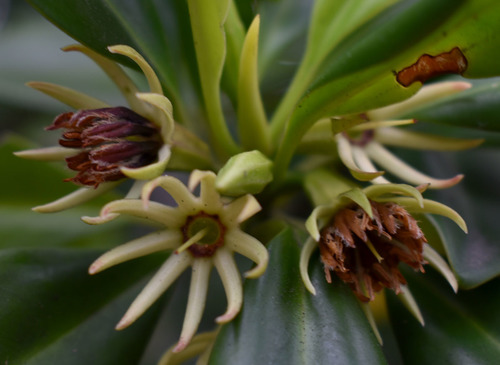
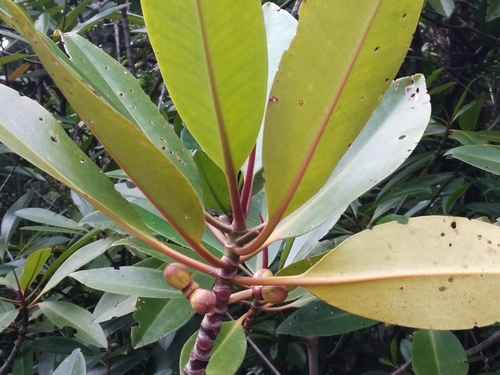
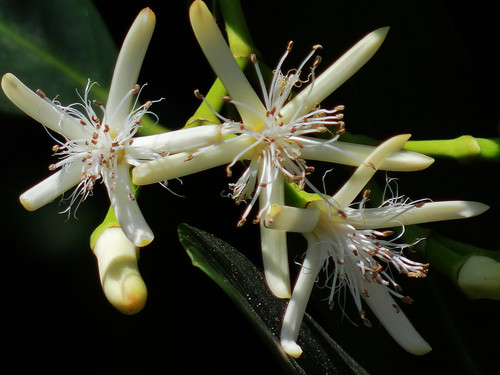
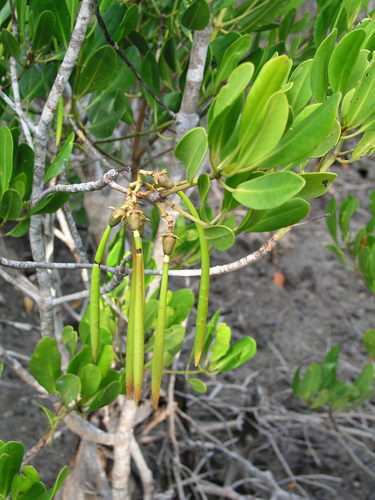
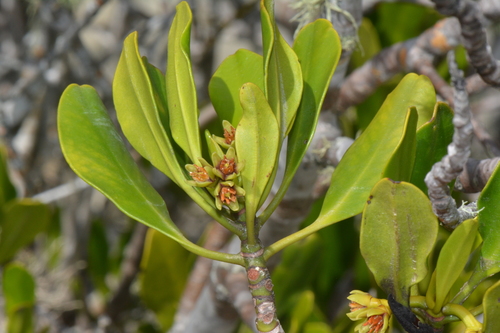
Ceriops tagal (Perr.) C.B.Rob. is a medium-sized mangrove tree that reaches up to 25 metres (80 ft) in height, with a trunk diameter that can grow up to 45 cm (18 in). It has a columnar or multi-stemmed growth habit, and develops large buttress roots. Its radiating anchor roots are sometimes exposed and may loop upward in some locations. The bark ranges from silvery-grey to orangish-brown, is smooth, and has occasional pustular lenticels. Its leaves grow in opposite pairs, are glossy yellowish-green on the upper surface, obovate with entire margins, and reach up to 6 cm (2.4 in) long and 3 cm (1.2 in) wide. Flowers are produced singly in leaf axils; each flower has a long stalk, a short calyx tube, and floral parts arranged in groups of five or six. Paired stamens are enclosed inside the petals, which open explosively when disturbed. The ovoid fruits grow up to 3 cm (1 in) long, and are suspended from the shrunken calyx tube. Fruits are brown when young, change color as they mature, and eventually the hypocotyl emerges. The hypocotyl is long, slender, grows to around 35 cm (14 in) long, and is ribbed. This ribbed characteristic distinguishes Ceriops tagal from the related smooth-fruited yellow mangrove Ceriops australis. Ceriops tagal grows naturally in eastern and southern Africa, Madagascar, Seychelles, India, Maldives, China, Indo-China, Malesia, Papuasia, the Caroline Islands, New Caledonia and Australia. It inhabits brackish water areas in tidal zones. The durable wood of Ceriops tagal is used for house construction. It is also used to make charcoal, and is a preferred firewood, ranked second only to Rhizophora species. A dye can be extracted from the tree's bark; among mangrove species, its bark and sap produce red and black dyes that are used in batik and for tanning leather. In the Philippines, extracts called barok, taken from the dried bark known as marka tungog or tangal, are used as bittering and fermenting agents for the traditional bahalina palm wine. These extracts give the wine a deep brown-orange color and a bitter tangy aftertaste, and the bark is also used to tan and dye leather.