About Ceriops australis (C.T.White) Ballment, T.J.Sm. & J.A.Stoddart
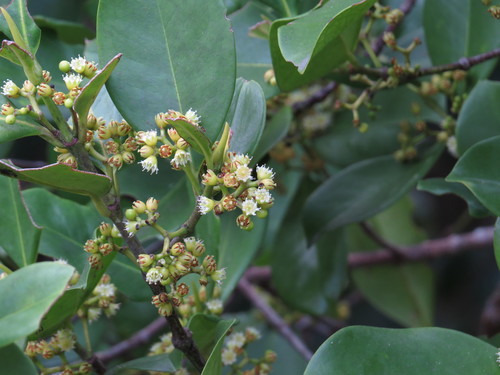
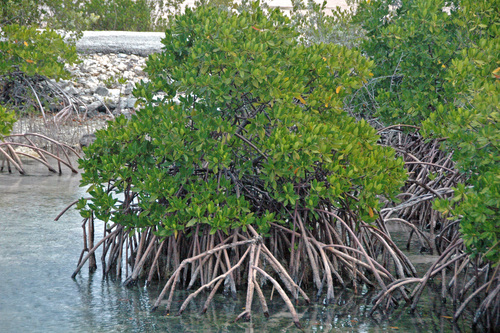
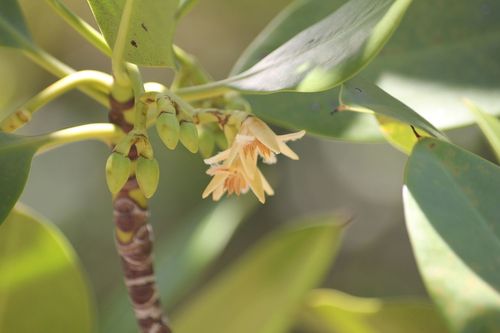
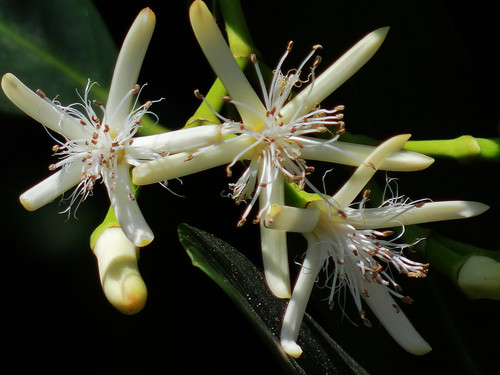
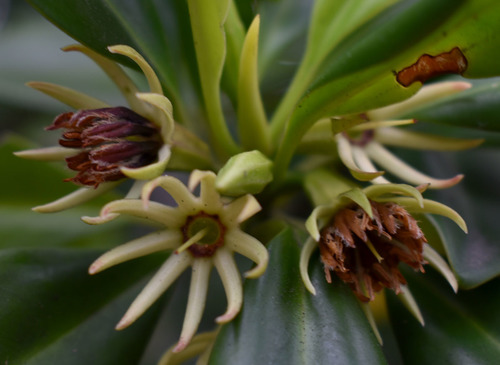
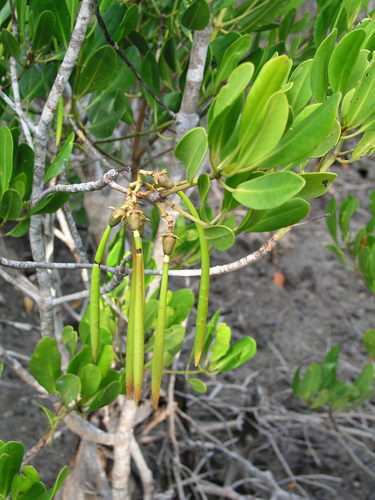
Ceriops australis is a small evergreen tree or shrub that reaches a maximum height of about 10 meters (30 feet). It has a columnar or multi-stemmed growth habit and develops large buttress roots. Its bark ranges from silvery-grey to orangeish-brown, is mostly smooth, and has occasional lenticels. The leaves grow in opposite pairs; they are glossy yellowish-green on the upper surface, obovate with entire margins, and can grow up to 6 cm (2.4 in) long and 3 cm (1.2 in) wide. Flowers grow singly in leaf axils, each has a short calyx tube, and floral parts are arranged in groups of five or six. The fruit is pear-shaped and suspended from the shrunken calyx tube; it is brown when young, changes colour as it matures, and the hypocotyl emerges from it. The hypocotyl is long, slender, smooth, and can reach up to 15 cm (6 in) in length. This species is a viviparous mangrove: the propagule emerges from the end of the fruit, falls from the parent tree, and then develops into a new plant. It is very similar in appearance to Ceriops tagal, and the two species grow alongside one another. Previously the two were considered the same species, but genetic evidence has now confirmed they are distinct. The most visible difference between the two can be seen during fruiting: the hypocotyls of C. tagal are ribbed, while those of C. australis are smooth. In tropical northern Australia, C. australis is the dominant mangrove species in estuarine habitats. Its range extends from Exmouth in Western Australia to the southern end of Moreton Bay in Queensland. Due to past confusion with C. tagal, its distribution and status in New Guinea remain unclear. It cannot tolerate strong wave action, high winds, or strong currents. It prefers drier sites with high salinities, located on the landward side of coastal mangrove strips and bordering salt pans. Indigenous Australians have traditionally used this tree to make digging sticks, throwing sticks, and spear shafts. An infusion made from the inner bark has been used to treat skin problems, while the outer bark has been used as a dye and for tanning leather. The larvae of the moth Syntherata janetta feed on the foliage of this species.