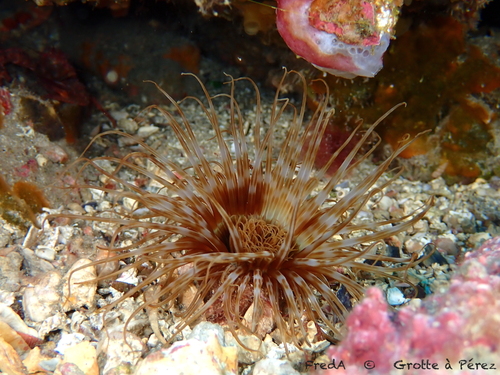
About Cerianthus membranaceus (Gmelin, 1791)
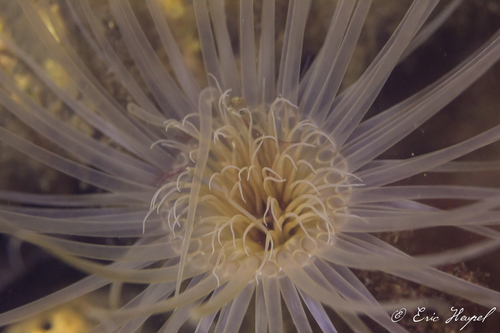
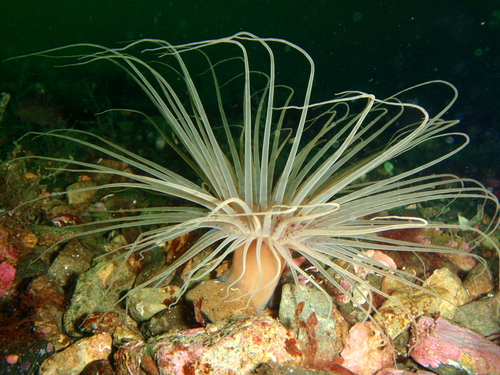
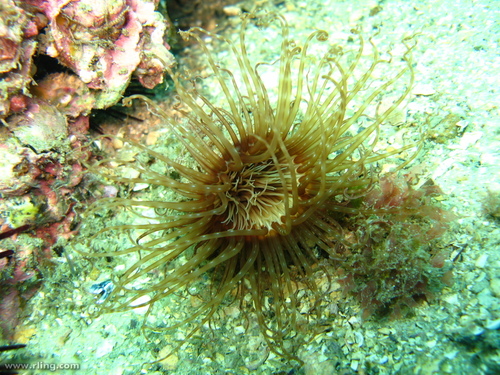
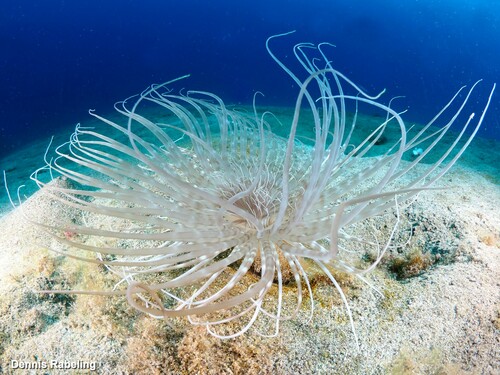
Cerianthus membranaceus is a large tube-dwelling anemone. Its oral disc can reach a diameter of up to 40 cm (16 in). It has two whorls of tentacles, with a total of around two hundred tentacles. The outer whorl consists of long, slender tentacles armed with stinging cells called cnidocytes, which are used to catch prey. The inner whorl has shorter tentacles that function to move captured food to the central mouth. The tentacles are sometimes banded, and can be a wide range of colours including white, yellow, orange, green, brown, blue, black, purple and violet. The colour of the inner whorl often contrasts with the colour of the outer whorl. The column of this tube anemone secretes mucus that contains a unique type of cnidocytes, which mesh together to form a fibrous structure. Sand and other particles stick to this structure, forming a leathery, protective tube that can be up to 40 cm (16 in) long. This species has no pedal attachment, and the lower end of the tube is buried in soft substrate. The base of the tube is open, which allows water to escape when the anemone retreats inside. Cerianthus membranaceus lives on the seabed in shallow water in the Mediterranean Sea, the northern Adriatic Sea and the northeastern Atlantic Ocean, with its range extending as far north as Britain. It occurs on sandy or silty substrates, where its tube is buried vertically in sediment. In the Mediterranean, it is mainly found in areas with high levels of organic matter, such as polluted zones off Marseille, where it occurs at high densities year-round. The tentacles of Cerianthus membranaceus cannot retract, but the entire animal can retreat into its tube. When it retreats, some tentacles grip the rim of the tube and pull it closed behind the anemone, making it effectively hidden from view. The tube is usually a permanent home, but if the anemone is disturbed from below—for example by a burrowing sea urchin—it can leave its tube, move to a new location, and secrete a new tube. Cerianthus membranaceus feeds on small fish and planktonic organisms that it catches with its tentacles. It is a protandrous hermaphrodite, meaning it starts life as a male and becomes female later in life. It releases gametes into the sea; after fertilisation, developing larvae drift with plankton for a long time before settling on the seabed and undergoing metamorphosis into juvenile polyps. Many commensal organisms use the tube as a refuge, especially polychaete worms and shrimps. The horseshoe worm Phoronis australis often attaches to the outside of the tube, with between twenty and fifty horseshoe worms associating with a single tube anemone. The lifespan of C. membranaceus in the wild is not known, but some individuals have lived in a tank at Naples Aquarium for more than fifty years.